Types of Surgical Scissors and Their Uses: A Complete Guide
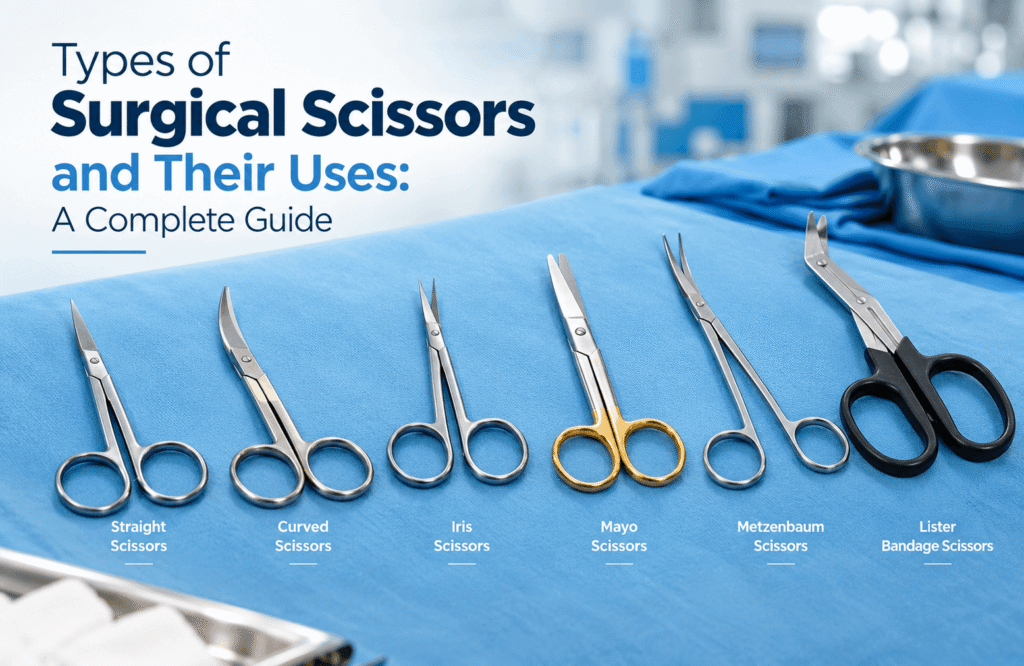
Common types of surgical scissors, including straight, curved, Iris, Mayo, Metzenbaum, and Lister bandage scissors, and their common uses.
TL;DR:
Surgical scissors are specialized instruments used to cut tissue, sutures, dressings, and other surgical materials. Common types include Mayo, Metzenbaum, Iris, tenotomy, suture, bandage, Lister, and Potts-Smith scissors. Their blade shape, tip design, size, and construction help determine the intended use.
The key distinction is simple: heavier scissors generally handle heavier cutting tasks, while finer scissors support delicate dissection and precision work. Exact applications can vary by procedure, specialty, instrument design, and facility practice.
What Are Surgical Scissors?
Surgical scissors are precision cutting instruments designed for use in medical and surgical settings. Their construction differs from ordinary scissors because surgical procedures require controlled cutting, predictable handling, and instrument designs suited to specific tasks.
A surgical scissor can differ in:
- Blade length and thickness
- Overall instrument size
- Straight, curved, or angled blades
- Sharp or blunt tips
- Handle and finger-ring design
- Intended cutting material
- Tissue or procedural application
Why Are Surgical Scissors Different From General Scissors?
Surgical scissors support specific clinical tasks. General scissors usually perform broad cutting functions, while surgical scissors use specialized designs for tissue, sutures, dressings, or fine dissection.
Expert Note: Never identify a surgical scissor by its name alone. Check its overall design, blade configuration, tip shape, size, and intended application.
The next section breaks down the major surgical scissors you are most likely to encounter.
What Are the Main Types of Surgical Scissors?
The main types of surgical scissors include Mayo, Metzenbaum, Iris, operating, dissecting, suture, bandage, Lister, tenotomy, and Potts-Smith scissors. Each design supports a different cutting or dissection requirement.
What Are Mayo Scissors Used For?
Mayo scissors are robust surgical scissors commonly used for cutting heavier tissue or surgical materials. They are available in straight and curved configurations.
Key features of Mayo scissors
- Use a relatively robust blade design.
- Come in straight and curved forms.
- Support heavier cutting tasks.
- May be used for tissue or material cutting depending on the specific instrument and procedure.
Curved Mayo scissors are commonly associated with cutting heavier tissue, while straight Mayo scissors can be used for sutures or other materials in appropriate settings.
The exact application depends on the instrument specification and surgical procedure.
Mayo scissors identification
Look for a comparatively substantial blade and heavier construction. Their robust appearance helps distinguish them from finer scissors such as Metzenbaum or Iris scissors.
What Are Metzenbaum Scissors Used For?
Metzenbaum scissors are commonly used for delicate tissue dissection and fine surgical cutting tasks. Their relatively slender blades provide controlled handling for delicate work.
Key features of Metzenbaum scissors
- Use a relatively slender design.
- Commonly feature long handles relative to blade size.
- Come in straight and curved variations.
- Support delicate tissue dissection.
Mayo vs Metzenbaum
Mayo and Metzenbaum scissors can look similar because both may have curved or straight configurations. Their construction and intended applications differ.
| Feature | Mayo Scissors | Metzenbaum Scissors |
|---|---|---|
| General construction | More robust | More delicate |
| Typical application | Heavier tissue/material cutting | Delicate tissue dissection |
| Blade profile | Relatively substantial | Relatively slender |
| Common configurations | Straight and curved | Straight and curved |
Expert Note: A common identification error occurs when students identify scissors only by length. Blade thickness, handle-to-blade proportions, and overall construction provide additional identification clues.
What Are Iris Scissors Used For?
Iris scissors are small, fine scissors used for precision cutting and delicate surgical tasks. They are available in straight and curved designs.
Their compact size and fine blades distinguish them from larger general-purpose surgical scissors.
Iris scissors features
- Use small blades.
- Support fine cutting.
- May have straight or curved blades.
- Provide control for delicate work.
The specific application depends on the surgical specialty and instrument configuration.
What Are Operating Scissors?
Operating scissors are a broad category of surgical scissors used for cutting tissue or surgical materials during procedures. The term does not necessarily describe one standardized instrument.
Operating scissors may vary by:
- Blade length
- Blade thickness
- Tip configuration
- Straight or curved design
- Sharp or blunt tips
- Intended surgical application
Because terminology can vary between manufacturers and clinical settings, identification should rely on the instrument’s physical characteristics and labeled specification.
What Are Dissecting Scissors Used For?
Dissecting scissors support controlled tissue separation and cutting during surgical dissection. Their design can include straight or curved blades and sharp or blunt tips.
The appropriate configuration depends on the tissue, surgical approach, visibility requirements, and procedure.
Why does blade design matter?
A curved blade can provide access around anatomical structures. A straight blade can provide a more direct cutting path. Tip configuration can also affect how the instrument interacts with tissue.
What Are Suture Scissors Used For?
Suture scissors are designed to cut sutures and support suture-related tasks. Their specialized blade or tip configuration distinguishes them from general tissue scissors.
Some instruments are specifically designed for suture removal, while others support cutting during closure or other procedural steps.
What scissors are used to remove sutures?
Suture-removal scissors are commonly designed to cut the suture while helping maintain controlled contact with the surrounding skin. Specific designs vary.
Expert Note: Do not assume that every sharp surgical scissor is appropriate for cutting sutures. Instrument selection should follow the procedure, instrument specification, and clinical practice.
What Are Bandage Scissors Used For?
Bandage scissors are designed to cut dressings, bandages, and related materials while reducing the risk of accidental skin contact.
A common bandage-scissor design uses an angled blade with a blunt or protective tip.
Why do bandage scissors have a blunt tip?
The blunt tip helps protect the patient’s skin when the instrument passes beneath or alongside dressing material. The angled design can also improve access when cutting around dressings.
What Are Lister Bandage Scissors?
Lister bandage scissors are specialized dressing scissors that use an angled design and a protective blunt foot. They are commonly associated with dressing and bandage removal.
The foot helps separate the cutting edge from the patient’s skin during appropriate use.
What Are Tenotomy Scissors Used For?
Tenotomy scissors are small, fine scissors designed for delicate tissue cutting and dissection. They may be available in straight or curved configurations.
Their fine construction makes them suitable for situations requiring controlled manipulation and precise cutting.
Tenotomy scissors can appear in different surgical specialties. Their exact use depends on the procedure and instrument configuration rather than the name alone.
What Are Potts-Smith Scissors Used For?
Potts-Smith scissors are specialized scissors with angled blades used for controlled cutting in vascular and other surgical applications.
The angled configuration can help provide access and visibility when the surgeon works within a confined anatomical area.
Instrument specifications can vary, which makes the exact blade angle and application important when identifying the instrument.
What Other Specialized Surgical Scissors Exist?
Other specialized designs include:
- Endarterectomy scissors — support specialized vascular procedures.
- Littauer scissors — commonly associated with suture-related cutting.
- Umbilical scissors — designed for specific obstetric applications.
- Episiotomy scissors — designed for controlled cutting during episiotomy procedures.
- Vascular scissors — support specialized vascular cutting tasks.
- Ophthalmic scissors — provide fine cutting for delicate ophthalmic procedures.
Specialized instruments should be identified using the manufacturer’s specifications, institutional references, and procedure-specific training.
How Are Surgical Scissors Classified?
Surgical scissors can be classified by blade shape, tip design, intended use, and construction. These attributes provide a more reliable identification framework than memorizing names alone.
Classification by Blade Shape
Straight surgical scissors
Straight scissors use blades that follow a direct line from the handle. They can support direct cutting of materials, sutures, and selected tissue tasks.
Curved surgical scissors
Curved scissors use blades that follow a curved profile. They can improve access and maneuverability during tissue dissection and work around anatomical structures.
Angled surgical scissors
Angled scissors position the blades at an angle relative to the instrument shaft. This configuration can improve access and visibility in selected surgical applications.
Classification by Tip Design
Surgical scissors can also use different tip configurations:
- Sharp–sharp: Both tips have sharp points.
- Sharp–blunt: One tip is sharp while the other is blunt.
- Blunt–blunt: Both tips have blunt ends.
Tip design affects how the instrument interacts with tissue and surrounding structures.
Classification by Intended Use
Another useful classification includes:
- Tissue cutting
- Delicate tissue dissection
- Suture cutting
- Dressing and bandage cutting
- Fine or precision cutting
- Specialized vascular cutting
Classification by Construction
Surgical scissors may also be classified as:
- Reusable instruments
- Disposable instruments
- Standard surgical scissors
- Specialty-specific scissors
Reusable instruments require processing according to applicable manufacturer instructions and facility protocols.
What Is the Difference Between Straight and Curved Surgical Scissors?
Straight scissors provide a direct cutting path, while curved scissors can improve access and maneuverability around anatomical structures. Neither configuration is universally preferable; the intended task determines the appropriate design.
| Feature | Straight Scissors | Curved Scissors |
|---|---|---|
| Blade shape | Straight | Curved |
| Cutting path | Direct | Curved |
| Common advantage | Direct cutting | Access and maneuverability |
| Typical applications | Materials, sutures, selected tissue tasks | Tissue dissection and contoured areas |
| Identification clue | Linear blade profile | Curved blade profile |
When are straight scissors used?
Straight scissors can support direct cutting tasks, including selected material and suture applications.
When are curved scissors used?
Curved scissors can support tissue dissection and cutting around anatomical structures where the blade curvature provides useful access.
The correct choice depends on the procedure, anatomy, instrument design, and surgical team’s established practice.
What Is the Difference Between Sharp and Blunt Surgical Scissors?
Sharp scissors provide precise cutting edges, while blunt scissors reduce the exposure of pointed tips during tasks where blunt contact is preferred. Sharp-blunt designs combine these characteristics in one instrument.
Sharp-tipped scissors
Sharp tips support precise cutting and fine dissection when the procedure requires controlled tissue separation.
Blunt-tipped scissors
Blunt tips can reduce the risk associated with pointed ends during selected procedures and material-cutting tasks.
Sharp-blunt scissors
A sharp-blunt configuration places different tip designs on the two blades. This arrangement can support cutting while limiting the presence of two pointed tips.
Tip selection should always match the intended task and established surgical practice.
What Is the Difference Between Mayo and Metzenbaum Scissors?
Mayo scissors generally use a heavier construction for heavier cutting tasks, while Metzenbaum scissors use a finer design for delicate tissue dissection.
| Feature | Mayo | Metzenbaum |
|---|---|---|
| Construction | More robust | More delicate |
| Typical use | Heavier tissue/material cutting | Delicate tissue dissection |
| Blade profile | Relatively heavy | Relatively slender |
| Common forms | Straight and curved | Straight and curved |
Which scissors are generally used for delicate tissue?
Metzenbaum scissors are commonly used for delicate tissue dissection because their slender design provides finer control than heavier scissors such as Mayo scissors.
This distinction helps surgical technology students recognize instruments during identification exercises and sterile-field preparation.
Surgical Scissors Names and Uses: Quick Reference
| Surgical Scissors | Main Use | Key Identification Feature |
|---|---|---|
| Mayo scissors | Heavier tissue or material cutting | Robust blade design |
| Metzenbaum scissors | Delicate tissue dissection | Slender design |
| Iris scissors | Fine cutting | Small, fine blades |
| Bandage scissors | Dressing and bandage cutting | Angled design, protective tip |
| Suture scissors | Suture cutting | Specialized cutting design |
| Tenotomy scissors | Fine tissue dissection | Small, precise construction |
| Potts-Smith scissors | Specialized vascular cutting | Angled blades |
| Lister scissors | Dressing and bandage removal | Protective blunt foot |
Important: Instrument names and applications can vary between manufacturers, specialties, and clinical settings. Use the instrument’s specification and institutional reference when exact identification matters.
How Do You Choose the Appropriate Surgical Scissors?
The appropriate surgical scissors depend on the material, required precision, anatomical access, tip configuration, procedure, and established clinical practice.
Identify the Material Being Cut
Determine whether the task involves:
- Tissue
- Sutures
- Dressings
- Bandages
- Other surgical materials
Different materials require different cutting characteristics.
Determine the Required Precision
Fine tissue work may require a smaller or more delicate instrument. Heavier material may require a more robust design.
Consider Access and Depth
Straight and curved blades provide different approaches to the operative field. Curvature can help when the instrument must work around anatomical structures.
Check Tip Design
Identify whether the scissors use:
- Sharp tips
- Blunt tips
- Sharp-blunt tips
Tip configuration should match the intended task.
Consider the Procedure
Specialized procedures can require specialized instruments. The procedure-specific preference should guide instrument selection.
Check Instrument Condition
Before use, surgical personnel should identify visible damage, alignment problems, corrosion, or other defects according to facility procedures.
Follow Processing Requirements
Reusable surgical scissors require cleaning, inspection, and sterilization according to applicable manufacturer instructions and healthcare-facility protocols.
Expert Note: Surgical instrument processing is not a one-size-fits-all procedure. Follow the manufacturer’s validated instructions and your facility’s infection-prevention policies.
How Do Surgical Technologists Handle Surgical Scissors?
Surgical technologists support safe instrument management throughout the perioperative process. Their responsibilities can include identifying instruments, preparing the sterile field, maintaining organization, and following facility procedures.
Key responsibilities can include:
- Identify the appropriate instrument before a procedure.
- Inspect scissors for visible damage or malfunction.
- Organize instruments on the sterile field.
- Pass instruments according to established practice and procedure requirements.
- Maintain awareness of the surgeon’s procedural needs.
- Separate damaged or malfunctioning instruments according to facility policy.
- Support appropriate cleaning and sterilization workflows for reusable instruments.
The exact responsibilities of a surgical technologist vary by jurisdiction, facility, role, and scope of practice.
What Are Common Mistakes When Identifying Surgical Scissors?
Students and new surgical personnel can confuse scissors when they rely on only one visual feature.
Common identification mistakes include:
- Confusing Mayo and Metzenbaum scissors because both may have straight or curved forms.
- Assuming every curved scissor has the same function.
- Identifying instruments only by overall size.
- Ignoring tip configuration.
- Ignoring blade thickness.
- Assuming an instrument name represents one exclusive application.
- Using an instrument outside its intended purpose.
A reliable identification process combines several attributes rather than one feature.
How Can You Identify Surgical Scissors at a Glance?
Identify surgical scissors by examining their size, blade shape, tips, blade thickness, configuration, and intended application.
Use this seven-step checklist:
Check the overall size
Compare the instrument with known surgical scissors.
Examine the blade shape
Determine whether the blades are straight, curved, or angled.
Check the tips
Identify sharp, blunt, or sharp-blunt tips.
Examine blade thickness
A robust blade can indicate a heavier cutting application, while a slender blade can indicate finer work.
Compare blade-to-handle proportions
The relationship between blade length and handle length can help distinguish similar instruments.
Consider the intended task
Ask whether the instrument is designed for tissue, sutures, dressings, or another material.
Confirm the instrument name
Use the instrument label, manufacturer’s reference, or approved institutional identification resource when confirmation is required.
This method gives surgical technology students a practical way to connect instrument appearance, design,intended use.
FAQs
What are the main types of surgical scissors?
The main types include Mayo, Metzenbaum, Iris, operating, dissecting, suture, bandage, Lister, tenotomy, and Potts-Smith scissors. Each type uses a specific combination of blade shape, tip design, size, and construction for particular cutting or dissection tasks.
What are Mayo scissors used for?
Mayo scissors are commonly used for heavier tissue or surgical-material cutting. Their robust construction distinguishes them from finer scissors. Straight and curved versions exist, and their exact application depends on the procedure and instrument configuration.
What are Metzenbaum scissors used for?
Metzenbaum scissors are commonly used for delicate tissue dissection. Their relatively slender blades and controlled handling distinguish them from heavier scissors such as Mayo scissors. They are available in straight and curved configurations.
What is the difference between Mayo and Metzenbaum scissors?
Mayo scissors generally have a more robust construction and support heavier cutting tasks. Metzenbaum scissors generally have a finer, more slender design and support delicate tissue dissection. Both can have straight or curved blades.
What scissors are used to cut sutures?
Suture scissors are specifically designed for cutting sutures. Some specialized scissors support suture removal. The correct instrument depends on the procedure, suture material, instrument design, and clinical practice.
What are bandage scissors used for?
Bandage scissors are used to cut dressings, bandages, and related materials. Many designs use an angled blade and blunt or protective tip to help reduce accidental skin injury during appropriate dressing removal.
What is the difference between straight and curved surgical scissors?
Straight scissors provide a direct cutting path. Curved scissors can improve access and maneuverability around anatomical structures. The appropriate configuration depends on the surgical task, anatomy, procedure, and instrument design.
What are Iris scissors used for?
Iris scissors are small, fine scissors used for precision cutting and delicate surgical tasks. They may have straight or curved blades. Their compact size and fine construction distinguish them from larger general-purpose surgical scissors.
Key Takeaways
- Surgical scissors perform specialized cutting tasks involving tissue, sutures, dressings, and surgical materials.
- Mayo scissors use a robust design for heavier cutting applications.
- Metzenbaum scissors use a finer design for delicate tissue dissection.
- Iris scissors provide fine cutting control through their small, precise construction.
- Straight, curved, and angled blades support different access requirements.
- Sharp and blunt tips provide different handling characteristics.
- Surgical technologists identify scissors using multiple physical attributes, not instrument names alone.
- Instrument selection should follow the procedure, instrument specification, facility policy, and established surgical practice.
- Reusable scissors require appropriate processing according to manufacturer instructions and facility protocols.
Expert Note: Surgical instrument identification becomes more reliable when you connect three elements: what the instrument looks like, what it is designed to do, and where it is used. This approach helps students move beyond memorization and recognize instruments in practical settings.
Medical Disclaimer: This article is for educational purposes only. It does not replace professional medical training, institutional policies, manufacturer instructions, or guidance from qualified healthcare professionals.