Surgical Equipment Market Growth Trends Advancing Healthcare Technology
Surgical Equipment Market Growth Trends Advancing Healthcare Technology
The global market for surgical devices is evolving, as surgeons turn to new technologies to increase the chances of success in their procedures and make operations safer for patients. The increase of surgical services, the aging population, the rise of chronic diseases as well as investment in the health sector contribute to this market expansion.
The modern surgical equipment market goes beyond the previously used standard tools, like scalpels, forceps, scissors, retractors, and clamps. Today’s market comprises robotic surgical devices, advanced electrosurgery equipment, image-guided technologies, Artificial-Intelligence-based systems, digital operating rooms, and other equipment specifically intended for minimally invasive processes.
As stated in Research Report on Surgical Equipment Market, the global surgical equipment market is expected to grow consistently until 2034. Instruments, power tools, and electrosurgical devices are still major categories. Moreover, the increasing demand for technologies ensuring precision, effectiveness, and reduction of recovery time is observed.
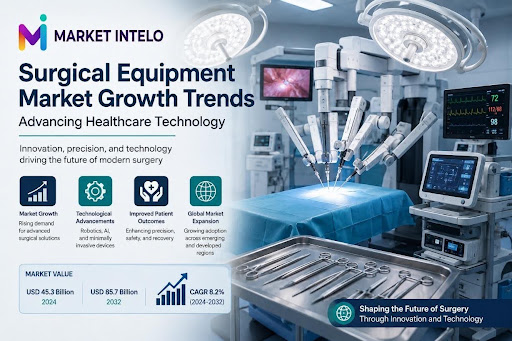
According to Market Intelo. the global market for surgical Equipment was priced at $18.6 billion in 2025 and is predicted to total $34.1 billion by 2034, obtaining a CAGR of 6.9% through the forecasting period of 2026 to 2034.
Growing Trend of Minimally Invasive Surgeries
The most prominent change happening in the surgical instruments sector is the transition from traditional open surgery to minimally invasive techniques such as laparoscopic, endoscopic, arthroscopic, and catheter-based surgeries that use smaller incisions and unique surgical instruments to make procedures possible in tight places.
Minimally invasive surgery methods have various advantages when in use in particular clinical situations such as lesser blood loss, shorter hospital stay, and lower postoperative pain.
These advantages are fueling the investments of hospitals and surgical clinics in advanced surgical equipment for minimally invasive treatments.
The growing demand for these procedures is supporting the development of:
- Graspers, scissors, dissecting instruments, and retractors for laparoscopic surgeries
- Visualization equipment capable of producing images in high definition and 3D
- Endoscopic devices which are either flexible or rigid
- Advanced energy devices for sealing blood vessels
- Image guided surgeries using guided images
- Small instruments for outpatient surgeries.
Different branches of medicine and surgery have started to use minimally invasive techniques, including general surgery, gynecology, urology, orthopedics, and cardiac surgery. With the increase of complicated techniques in this field, companies are working on the development of better flexibility, ergonomics, visualization, and precision of the surgical instruments.
Growth of Robotic-Assisted Surgery
The effect of robotic surgery is also another significant driver for progress in the field of surgical equipment. During the operations, robotic devices have enabled surgeons to observe the area, navigate better, reach areas that are difficult to access, and operate more efficiently. As a result, robotic surgery is raising the demand for the following products:
- Robotic-compatible surgical instruments
- Specialized energy equipment
- 3D imaging machines
- Robotic tables
- Sterile drapes and disposable items
- Surgical planning and navigation software.
Surgical robots can be used in many areas: urology, gynecology, surgery, thoracic surgery, and orthopedics. Healthcare institutions have started evaluating robotic systems in terms of the number of operations performed, personnel training needs, efficiency of operation rooms, cost of maintenance, and long-term effectiveness of the equipment.
Although robotics offer a number of benefits, it may involve high costs of purchasing and functioning. Healthcare agencies also should invest in staff training, technical aid, maintenance, and other consumables that would be needed. Thus, robotic systems are likely to be used mostly in hospitals and clinics with a sufficient number of operations performed and financial capacity.
Integration of Artificial Intelligence
The emergence of artificial intelligence technology is increasingly being integrated into surgical practices. Innovations in artificial intelligence can aid in preoperative preparation, image interpretation, navigation throughout surgery, and systematic observation of progress, among others.
Before any surgical procedure, AI innovations can help doctors with image analysis and drawing the necessary information for planning treatment. During surgery, computer vision and machine-learning systems assist in the recognition of instruments, mapping anatomy, understanding various processes during the operation, and the actual technicalities of surgical performance.
AI finds its application in operating-room management as well. In fact, hospitals can have full access to procedure duration, device utilization, and availability of workforce to identify problems and take corrective actions.
Introducing robotics to surgical field requires corresponding clinical validation, legal environment, protection of data, and quality of information which must be at the required level. Furthermore, AI applications need to be developed to meet the requirements of surgeons and not to generate unnecessary alerts or disturb regular surgical processes.
Development of Smart Operating Rooms
Intelligent operating rooms are emerging as a vital component of healthcare modernization. These facilities connect surgical machines, patient monitoring devices, imaging systems, video apparatus, communication equipment and hospital information systems via an integrated information technology platform
A connected operating room can support:
Control of surgical instruments and screens is exerted from a single location.
- Surgical videos are shared in real-time.
- Documentation and recording of the procedures are made digitally.
- Remote consultations and collaborative approach of various specialized surgeons are possible
- Training and educational processes have been improved.
- Equipment allocation is done more efficiently.
- Surgical teams have become better organized.
The use of integration in the operating room may reduce superfluous movements and assist medical specialists in obtaining useful data quickly. It may also help the cooperation between doctors, nurses, and other patients´ specialists working outside of the hospital environment. That said, some hospitals may experience problems with compatibility, security, reliability of the infrastructure network, compatibility of systems, and training of employees.. Equipment produced by various manufacturers may not always be able to communicate effectively, making standardization of devices an essential factor to be considered by health organizations.
Advances in Electrosurgical Equipment
Although developed for cutting, coagulation, tissue division, and bleeding management, electrosurgical instruments are now being turned into advanced devices through the implementation of new technologies such as ultrasonic, hybrid, and bipolar devices with the goal to make energy delivery effective with lower possibility of causing damage to surrounding tissues.
Apart from that, surgical operations, whether laparoscopic, robotic, or open, will witness a rise in the adoption of these devices.
Developers have been concentrating on growing their lines of technologies in numerous important directions.
Enhancements in feedback from tissue.
- Automatic energy adjustment.
- More ergonomic and smaller designs of instruments.
- Compatibility with robotic surgical systems.
- Better performance in vessel sealing.
- Integration with surgical visualization.
The increased use of advanced electrosurgery devices will be due to hospitals performing complicated operations while utilizing technology that allows precise and safe surgical procedures.
The Rise of Infection Control Measures
Infection control remains one of the priorities of surgical practice. Medical institutions are reviewing devices to ascertain features such as durability, performance, and sterilization requirements.
Some hospitals have started to implement one-time-use surgical instruments in limited procedures. In addition to being easy to manage, one-time-use instruments eliminate the dependence on the equipment need for reprocessing. However, there are some drawbacks in that process such as procurement costs, waste production, use of materials, and environmental sustainability.
There is a trend of re-invention of reusable instruments to optimize the cleaning and sterilization process. Manufacturers are producing instruments with fewer areas that cannot be reached during inspection and cleaning.
The presence of digital tracking systems enable hospitals in tracing the instruments through medical instruments, process of sterilization, maintenance schedules, and availability of the instruments.
The amount of reusable and one-time-use equipment will depend on the nature of the procedure, infection-control policies, and resources of the facility.
Expansion of Ambulatory Surgical Centers
At this time, the development of outpatient surgical facilities is opening new doors for producers of surgical instruments. Today, operations that did once necessitate the hospitalization of patients are carried out in outpatient centers as long as the health and clinical picture of the patient permit this.
Outpatient clinics mainly use the instruments that meet the following requirements:
- compactness;
- efficiency;
- user-friendliness;
- high turnover time;
- limited maintenance needs;
- flexibility in installation.
Thus, outpatient surgical centers show growth in demand for:
- portable diagnostic devices;
- compact operation systems;
- battery-operated surgical amniotic sac tools;
- instruments sets designed for specific procedures;
- systems for disinfection and storage;
- tools specifically made for mass use.
The rise of outpatient surgery centers is especially important for ophthalmic, orthopedic, gastroenterological, surgical, and pain treatment operations. It pushes equipment suppliers to come up with ideas that balance productivity with low operational and installation costs.
Regional Market Development
The market for surgical equipment in North America shapes up as a significant one given the region’s advanced healthcare infrastructure, high volumes of surgical procedures, established hospital networks, and advanced practice of technologies that minimize surgery risks through robotics and minimally invasive techniques.
The focus of Europe is on the modernization of healthcare with patient safety, compliance with regulations, and procurement based on value. More and more hospitals in the region are assessing used equipment based on clinical and measurable benefits, effectiveness, cost efficiency, and sustainability.
The region of Asia Pacific has good chances for expansion due to the increasing number of hospital networks, more healthcare investments, better access to specialist care, and greater investment in healthcare technology. As far as the demand for surgical technologies is concerned, the following countries are likely to contribute to this demand: China, India, Japan, South Korea, and Australia.
Latin America and the Middle East are also putting money in hospitals, centers, and surgical facilities. However, issues such as the cost, availability of personnel, technical assistance, and import restrictions may hinder the increase of demand in developing regions.
Challenges Facing the Industry
Even though the prospects for the market for surgical instruments are optimistic, however, there are still some obstacles faced by manufacturers and health service providers. Since regulatory requirements can be complicated, especially for equipment with software, AI, robotic systems and connected devices, hospitals have to deal with high acquisition cost, costs related to the preservation of equipment, costs of software updates and training costs and the costs related to compatible disposables. Small facilities may find it challenging to adopt advanced solutions without external funding or models where the services are shared.
Other issues include:
- shortages in trained surgeons and other specialists
- malfunctioning supply chains that affect some components needed to make devices
- compatibility problems with machines of various manufacturers
- cybersecurity risk related to connected devices
- lack of infrastructure in some poorly developed markets
- waste disposal problems connected with the use of disposable machines
Manufacturers producing modular devices, as well as providing training and repair services, and servicing integrated systems will certainly have more chances to adapt to the changing circumstances in the healthcare sphere.
Future Outlook
The upcoming developments in surgical equipment’s segment can be attributed to the joint influence of health know-how, digitalization, robotics, analytics, and modern materials. Various devices—robot-assisted surgical systems, minimally invasive products, AI-powered equipment, navigation-supported surgeries, smart ORs, and advanced energy devices—are likely to dominate innovations in the industry.
A significant point here is that while it is true that innovative technologies are being developed today, this does not mean that they will begin to be used in hospitals. For example, the use of new equipment will depend on its effectiveness, safety, ease of operation, cost, training, and maintenance.
As the healthcare systems develop the capacity for surgery, producers will have to implement their innovative solutions into devices that will operate accurately, flexibly, and in harmony with different types of facilities. The most advanced equipment will be accepted by its users and will provide them with useful solutions.
To sum up, we can see that the current market for surgical devices continues to become more advanced and patient-centered. The modernization of surgical equipment will help hospitals to run more successfully, meet the requirements of the healthcare system, and provide patients with more access to surgical services.
Reference: https://marketintelo.com/report/surgical-equipment-market
Author Bio –
Ashish Kolte is a Marketing Manager at MarketIntelo with expertise in marketing, market intelligence, and business strategy. He combines marketing insights with industry research to analyze market trends, identify growth opportunities, and provide data-driven perspectives on emerging industries and global business developments.
LinkedIn: https://www.linkedin.com/in/ashishkolte/