A Day in the Life of a Surgical Technologist: Daily Routine, Responsibilities & OR Workflow (2026)
A Day in the Life of a Surgical Technologist Daily Routine, Responsibilities & OR Workflow (2026)
Quick Answer
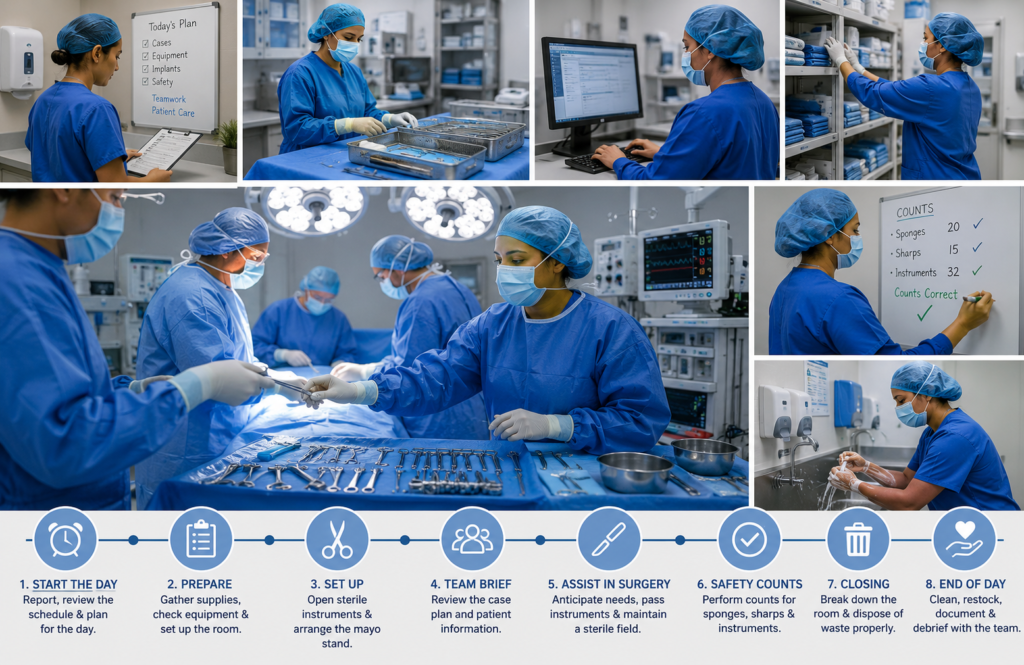
A Surgical Technologist plays a vital role in every stage of surgery. Their day starts by preparing the operating room, organizing sterile instruments, and making sure all equipment is ready before the patient arrives. During surgery, they assist the surgeon by passing instruments, maintaining a sterile environment, and keeping accurate surgical counts. After the procedure, they help clean and reset the operating room, restock supplies, and prepare everything for the next case. Every shift requires attention to detail, teamwork, and a strong commitment to patient safety.
Introduction
If you ask several Surgical Technologists what a typical workday looks like, you’ll probably get several different answers. While the responsibilities remain the same, every day brings a new combination of patients, procedures, and challenges. A routine morning can quickly change when an emergency surgery is added to the schedule, making flexibility one of the most important parts of the job.
Working in the operating room means being part of a fast-paced team where precision matters. Every instrument, every count, and every decision contributes to a safe surgical environment. Although patients may only see the surgical team for a few minutes before anesthesia, a tremendous amount of preparation happens behind the scenes long before the first incision is made.
Whether you’re considering becoming a Surgical Technologist, currently studying surgical technology, or simply curious about how the operating room functions, understanding a typical workday provides valuable insight into this profession.
The daily routine varies depending on several factors, including the hospital, surgical specialty, shift schedule, and patient volume. Someone working in a busy Level I trauma center may assist with multiple emergency procedures during a shift, while a technologist in an outpatient surgery center usually follows a more predictable schedule with planned procedures.
In this guide, you’ll follow a Surgical Technologist through an entire workday, from the early morning briefing and operating room preparation to assisting during surgery, completing post-operative responsibilities, and getting everything ready for the next patient.
What Does a Typical Day Look Like for a Surgical Technologist?
Every Surgical Technologist’s shift can be divided into three major phases:
- Preparing for surgery
- Assisting during surgery
- Completing post-operative responsibilities
Although each phase involves different tasks, they all share the same objective: providing a safe, sterile environment that allows the surgical team to deliver the best possible patient care.
| Stage | Time Frame | Primary Responsibilities |
|---|---|---|
| Pre-Operative | Before the patient enters the OR | Prepare instruments, verify sterilization, organize the sterile field, and check surgical equipment |
| Intra-Operative | During surgery | Pass instruments, maintain sterility, monitor surgical counts, and support the surgeon |
| Post-Operative | After surgery | Handle specimens, clean the operating room, restock supplies, document procedures, and prepare for the next case |
Most Surgical Technologists assist with multiple procedures during a single shift. After one surgery ends, they immediately begin preparing for the next one. Because of this continuous workflow, strong organizational skills, attention to detail, and efficient time management are just as important as technical surgical knowledge.
Typical Work Schedule and Shift Patterns
Surgical Technologists work in hospitals, outpatient surgery centers, specialty clinics, and other healthcare facilities. Their schedules vary depending on where they work and the type of surgical services offered.
Common shift patterns include:
- 8-hour shifts are common in outpatient surgery centers and clinics where procedures are scheduled during regular daytime hours.
- 10-hour shifts allow some hospitals to provide extended coverage while giving staff additional days off each week.
- 12-hour shifts are frequently used in hospitals with busy operating rooms that run throughout the day and night.
- On-call shifts require technologists to remain available outside their normal schedule in case emergency surgeries are needed.
- Overtime is common when complex operations take longer than expected or emergency cases interrupt the day’s schedule.
- Emergency surgeries can happen at any time, especially in trauma centers, requiring the surgical team to adjust quickly.
Unlike many healthcare careers with predictable routines, Surgical Technologists often work evenings, weekends, holidays, and overnight shifts because medical emergencies don’t follow a calendar.
Those employed in outpatient surgery centers generally enjoy more consistent schedules since most procedures are planned in advance and patients return home the same day. Hospital-based technologists, however, should expect greater variety and less predictable work hours.
Starting the Morning Before the First Surgery
For many Surgical Technologists, the workday begins well before the first patient enters the operating room.
Arriving early provides enough time to review the surgical schedule, attend the morning team briefing, inspect equipment, and prepare each operating room for the day’s procedures. Proper preparation reduces delays later and helps ensure every surgery starts safely and efficiently.
A Typical Morning Workflow
6:30 AM
Arrival at Hospital
        ↓
Morning Team Briefing
        ↓
Review Surgical Schedule
        ↓
Operating Room Setup
        ↓
Instrument & Equipment Verification
        ↓
Patient Preparation
        ↓
First Surgery Begins
During the morning briefing, surgeons, nurses, anesthesiology staff, and Surgical Technologists review the day’s procedures. The team discusses special equipment requirements, patient considerations, and any anticipated challenges before surgeries begin.
Once assignments are confirmed, the Surgical Technologist carefully checks every instrument tray to ensure it has been properly sterilized and contains all instruments needed for the scheduled procedure.
This inspection is more important than many people realize. Discovering that an instrument is missing or damaged after surgery has started can interrupt the procedure and potentially affect patient care. Careful preparation before the patient arrives helps prevent unnecessary delays and keeps the operating room running smoothly.
Starting the Morning Before the First Surgery
For many Surgical Technologists, the workday begins well before the first patient enters the operating room.
Arriving early provides enough time to review the surgical schedule, attend the morning team briefing, inspect equipment, and prepare each operating room for the day’s procedures. Proper preparation reduces delays later and helps ensure every surgery starts safely and efficiently.
A Typical Morning Workflow
6:30 AM
Arrival at Hospital
        ↓
Morning Team Briefing
        ↓
Review Surgical Schedule
        ↓
Operating Room Setup
        ↓
Instrument & Equipment Verification
        ↓
Patient Preparation
        ↓
First Surgery Begins
During the morning briefing, surgeons, nurses, anesthesiology staff, and Surgical Technologists review the day’s procedures. The team discusses special equipment requirements, patient considerations, and any anticipated challenges before surgeries begin.
Once assignments are confirmed, the Surgical Technologist carefully checks every instrument tray to ensure it has been properly sterilized and contains all instruments needed for the scheduled procedure.
This inspection is more important than many people realize. Discovering that an instrument is missing or damaged after surgery has started can interrupt the procedure and potentially affect patient care. Careful preparation before the patient arrives helps prevent unnecessary delays and keeps the operating room running smoothly.
Preparing the Operating Room
After the morning briefing, it’s time to prepare the operating room. This is one of the most important parts of a Surgical Technologist’s day because everything must be ready before the patient enters the OR. Even a small oversight can interrupt the procedure or create unnecessary delays.
Setting up an operating room isn’t simply arranging equipment. It’s a systematic process that follows strict sterile protocols to reduce infection risks and help the surgical team work efficiently. Every instrument, supply, and piece of equipment has a designated place, allowing the surgeon and the rest of the team to focus entirely on the patient.
A Surgical Technologist carefully organizes the room by completing several essential tasks, including:
- Establishing the sterile field by opening sterile supplies using proper aseptic technique and protecting the sterile environment throughout the setup process.
- Organizing surgical instruments so they are arranged in the order they’re most likely to be used during the procedure, making them easy to access.
- Preparing the Mayo stand with the primary instruments the surgeon will need immediately after the procedure begins.
- Setting up the back table with additional instruments, sutures, surgical sponges, dressings, and sterile supplies.
- Preparing personal protective equipment (PPE) for every member of the surgical team, including sterile gowns, gloves, masks, and protective eyewear.
- Inspecting surgical trays to confirm that the correct instruments are available, complete, and free from damage.
- Testing surgical equipment, including overhead lights, suction devices, electrosurgical units (ESUs), monitors, and other specialized equipment needed for the procedure.
Before surgery begins, every sponge, needle, blade, and instrument is counted and documented. These counts become part of the patient safety process and are repeated several times during the operation to ensure nothing is accidentally left inside the patient.
Although patients rarely see this preparation, it plays a critical role in preventing infections, reducing surgical errors, and helping procedures run smoothly from start to finish.
Preparing the Patient for Surgery
Once the operating room is ready, attention shifts to the patient.
While circulating nurses and anesthesia professionals manage most direct patient care before surgery, Surgical Technologists still play an important supporting role during this stage. Their responsibility is to help ensure that everything is in place before the first incision is made.
One of the first priorities is confirming the patient’s identity and the planned procedure. Working alongside the rest of the surgical team, the technologist helps verify the correct patient, the correct surgical site, and the correct procedure. These safety checks are standard practice in every operating room and significantly reduce the risk of preventable errors.
After verification, the patient is carefully positioned on the operating table. Proper positioning is essential because it provides the surgeon with the best possible access while protecting the patient from unnecessary pressure injuries or nerve damage during lengthy procedures.
The Surgical Technologist may also assist by:
- Helping prepare the patient’s skin using sterile techniques.
- Assisting with the placement of sterile surgical drapes.
- Ensuring sterile instruments remain protected until they’re needed.
- Confirming that all required equipment is functioning correctly before surgery begins.
Before the procedure starts, the entire surgical team participates in what’s known as the time-out procedure.
During this final safety pause, everyone in the operating room stops to confirm:
- The patient’s identity.
- The planned surgical procedure.
- The correct surgical site.
- Any special concerns or equipment required.
Although it only takes a few moments, this process is one of the most effective patient safety measures used in modern surgery.
Throughout patient preparation, Surgical Technologists work closely with circulating nurses, surgeons, and anesthesia providers to make sure everything is ready before surgery begins.
Responsibilities During Surgery
Once the surgeon makes the first incision, the Surgical Technologist’s role becomes even more active.
From this point until the operation is complete, they remain focused on maintaining a sterile environment while supporting the surgeon and the rest of the surgical team. Every movement inside the operating room is deliberate, and maintaining concentration is essential throughout the procedure.
Passing Surgical Instruments
Passing instruments is one of the most recognizable parts of the job, but it involves much more than simply handing tools to the surgeon.
Experienced Surgical Technologists learn to anticipate each step of a procedure. Instead of waiting to be asked, they often recognize which instrument will be needed next and have it ready before the surgeon requests it.
Developing this level of anticipation comes from experience, procedural knowledge, and understanding each surgeon’s preferred operating style.
Maintaining the Sterile Field
Sterility is the foundation of every surgical procedure.
Throughout the operation, the Surgical Technologist constantly watches for anything that could contaminate the sterile field. A torn glove, an improperly handled instrument, or accidental contact with a non-sterile surface must be identified immediately.
If contamination occurs, corrective action is taken without delay to protect the patient from infection.
Maintaining sterility requires continuous awareness from the beginning of the procedure until the final dressing is applied.
Performing Surgical Counts
One of the most important patient safety responsibilities is conducting accurate surgical counts.
Together with the circulating nurse, the Surgical Technologist counts every:
- Surgical sponge
- Needle
- Scalpel blade
- Instrument
- Miscellaneous surgical item
These counts are performed:
- Before surgery begins.
- Whenever additional items are opened.
- Before wound closure.
- At the end of the procedure.
If the count isn’t correct, surgery cannot safely conclude until every item has been located and accounted for.
This process helps prevent retained surgical items, one of the most serious and preventable surgical complications.
Handling Surgical Specimens
Many procedures involve removing tissue samples or organs that must be examined by a pathology laboratory.
The Surgical Technologist helps ensure specimens are:
- Properly identified.
- Correctly labeled.
- Safely preserved.
- Promptly transferred for laboratory analysis.
Even small labeling mistakes can affect diagnosis, making careful specimen handling an essential responsibility.
Managing Surgical Supplies
Throughout surgery, supplies are continuously monitored.
Additional sutures, implants, dressings, medications, irrigation fluids, or specialized instruments may be needed without much warning. The Surgical Technologist keeps track of available supplies and communicates with the circulating nurse whenever additional items are required.
Staying organized allows the surgeon to continue working without unnecessary interruptions.
Assisting the Surgeon
Depending on the procedure and facility policies, Surgical Technologists may also assist with tasks such as:
- Holding retractors.
- Operating suction devices.
- Controlling surgical instruments.
- Helping maintain clear visibility of the surgical site.
- Supporting hemostasis by preparing equipment used to control bleeding.
Every action is performed under the surgeon’s direction while maintaining sterile technique at all times.
Responding During Unexpected Situations
Not every surgery goes exactly as planned.
Unexpected bleeding, equipment malfunctions, changes in the patient’s condition, or emergency procedures can happen without warning.
During these moments, Surgical Technologists must stay calm, think quickly, and adapt without compromising patient safety or breaking sterile technique.
Their ability to remain composed under pressure is one of the qualities that makes them such valuable members of the surgical team.
Working With the Surgical Team
A successful surgery depends on teamwork. While the surgeon leads the procedure, every member of the operating room has a specific responsibility that contributes to patient safety and surgical efficiency.
As a Surgical Technologist, you’ll work closely with professionals from different specialties throughout the day. Clear communication, trust, and coordination allow the team to respond quickly, especially during complex or unexpected situations.
Here’s how each team member contributes during a typical surgical procedure:
- Surgeon: Leads the operation, performs the procedure, and makes all critical surgical decisions.
- Surgical First Assistant: Provides direct assistance to the surgeon by controlling bleeding, holding retractors, suturing, and supporting more advanced surgical tasks.
- Circulating Nurse: Manages everything outside the sterile field, including documentation, patient advocacy, obtaining additional supplies, and coordinating communication inside and outside the operating room.
- Scrub Nurse: In some healthcare facilities, a scrub nurse performs duties similar to those of a Surgical Technologist by managing sterile instruments and assisting the surgeon.
- Anesthesiologist: Administers anesthesia, monitors the patient’s vital signs, and ensures the patient remains stable throughout the procedure.
- Certified Registered Nurse Anesthetist (CRNA): Works alongside or under the supervision of an anesthesiologist to deliver and monitor anesthesia care.
- Sterile Processing Department (SPD): Cleans, sterilizes, inspects, and prepares surgical instruments before they’re returned to the operating room.
- Radiology Staff: Provides real-time imaging support during procedures that require fluoroscopy, X-rays, or other imaging technologies.
- Pathology Team: Examines tissue samples and surgical specimens removed during the procedure to help diagnose diseases and guide treatment decisions.
Although each professional has different responsibilities, everyone shares the same objective: delivering safe, efficient, and high-quality patient care.
In a busy operating room, even small communication errors can lead to delays or safety concerns. That’s why Surgical Technologists must develop strong teamwork and communication skills alongside their technical expertise.
How Responsibilities Change by Surgical Specialty
The daily routine of a Surgical Technologist isn’t the same in every operating room. While sterile technique, instrument management, and patient safety remain consistent across all specialties, the instruments, equipment, workflow, and pace often vary depending on the type of surgery being performed.
Some specialties involve routine scheduled procedures, while others require rapid decision-making during life-threatening emergencies.
Here’s how responsibilities can differ across surgical specialties:
General Surgery
General surgery exposes technologists to a wide variety of procedures involving the abdomen, digestive system, soft tissues, and endocrine organs.
Because no two cases are exactly alike, Surgical Technologists working in general surgery need broad knowledge of surgical instruments and procedures.
Orthopedic Surgery
Orthopedic procedures often involve repairing bones and joints using implants, screws, plates, rods, and powered surgical equipment.
Technologists in this specialty frequently manage:
- Orthopedic implant systems
- Surgical drills
- Bone saws
- Power reamers
- Large instrument trays
These procedures tend to require heavier equipment and additional preparation compared to many other specialties.
Cardiovascular Surgery
Cardiovascular surgery is one of the most technically demanding specialties.
Operations often last several hours and require specialized equipment such as:
- Heart-lung bypass machines
- Vascular instruments
- Cardiac retractors
- Fine microsurgical instruments
Because patient conditions can change rapidly, Surgical Technologists in cardiovascular surgery must remain highly focused throughout the procedure.
Neurosurgery
Neurosurgery demands exceptional precision.
Operations involving the brain or spine often require:
- Surgical microscopes
- Navigation systems
- Delicate microsurgical instruments
- Specialized positioning equipment
Even minor movements can affect the surgical outcome, making attention to detail especially important.
Plastic and Reconstructive Surgery
Plastic surgery focuses heavily on precision and cosmetic outcomes.
Technologists prepare fine instruments designed for delicate tissue handling and often assist with procedures requiring meticulous suturing techniques.
Obstetrics and Gynecology (OB/GYN)
OB/GYN technologists assist with procedures ranging from scheduled hysterectomies to emergency cesarean deliveries.
Because labor and delivery can change unexpectedly, flexibility and quick preparation are essential.
Pediatric Surgery
Working with infants and children requires specialized equipment designed for smaller anatomy.
Technologists must prepare pediatric-sized instruments while paying close attention to maintaining body temperature, minimizing blood loss, and supporting the unique needs of younger patients.
Trauma Surgery
Trauma surgery is among the fastest-paced environments in healthcare.
Patients often arrive without warning following serious accidents or medical emergencies.
In these situations, Surgical Technologists must:
- Prepare operating rooms rapidly.
- Locate specialized equipment quickly.
- Remain calm under intense pressure.
- Adapt to rapidly changing surgical priorities.
Every second matters in trauma care.
Robotic Surgery
As robotic-assisted procedures become more common, Surgical Technologists are increasingly responsible for preparing and managing robotic surgical systems.
This includes:
- Setting up robotic instruments.
- Assisting with robotic docking.
- Managing robotic accessories.
- Coordinating traditional instruments alongside robotic equipment.
Knowledge of robotic technology has become an increasingly valuable skill in today’s operating rooms.
Minimally Invasive Surgery
Laparoscopic and endoscopic procedures rely heavily on advanced visualization technology.
Technologists prepare:
- Laparoscopic towers
- Camera systems
- Light sources
- Specialized long instruments
- Carbon dioxide insufflation equipment
Although the incisions are much smaller, these procedures often require extensive equipment preparation before surgery begins.
Between Surgical Procedures
Many people assume the work ends once surgery is over, but that’s only part of the job.
The period between procedures, commonly called operating room turnover, is one of the busiest parts of the day. Every minute counts because the next patient is already being prepared.
A Surgical Technologist helps keep the surgical schedule running smoothly by completing several important tasks before the next case begins.
These responsibilities typically include:
- Removing used instruments and preparing them for transport to the Sterile Processing Department.
- Assisting with cleaning and disinfecting the operating room according to infection control guidelines.
- Restocking supplies that were used during the previous procedure.
- Preparing new sterile instrument trays.
- Updating documentation related to the completed surgery.
- Inspecting equipment to ensure everything is functioning correctly.
- Setting up the room for the next scheduled procedure.
Efficient turnover benefits everyone involved. It reduces delays, keeps surgeries on schedule, improves operating room productivity, and ensures the next patient receives timely care.
Experienced Surgical Technologists become highly skilled at organizing these tasks while maintaining strict infection prevention standards.
End-of-Day Responsibilities
As the shift comes to an end, there are still several important responsibilities to complete before leaving the operating room.
The final hours of the day focus on ensuring everything is ready for the next surgical team and that no equipment or documentation issues remain unresolved.
Common end-of-shift duties include:
- Completing final instrument counts.
- Reporting damaged or malfunctioning equipment.
- Organizing supplies for the following day’s schedule.
- Restocking surgical inventory.
- Completing outstanding documentation.
- Communicating important case information during shift handoff.
Hospitals that operate around the clock rely heavily on smooth communication between outgoing and incoming teams.
A thorough handoff helps maintain continuity of care, prevents miscommunication, and ensures the next team is fully prepared for upcoming procedures.
For Surgical Technologists, professionalism doesn’t end when the final surgery is complete. Every shift concludes with the same attention to detail that was required throughout the day.
Technology Used Throughout the Day
Today’s operating rooms are more advanced than ever, and Surgical Technologists work with a wide range of medical equipment every day. As technology continues to evolve, being comfortable with modern surgical systems has become an essential part of the profession.
While the exact equipment varies by hospital and surgical specialty, every Surgical Technologist is expected to understand how different devices function, recognize potential problems, and ensure everything is ready before surgery begins.
Some of the most commonly used technologies include:
Robotic Surgery Systems
Robotic-assisted surgery has become increasingly common for many minimally invasive procedures. Although the surgeon controls the robotic system, Surgical Technologists are responsible for preparing the equipment, attaching the appropriate instruments, troubleshooting basic issues, and ensuring everything is ready before the operation begins.
Surgical Navigation Systems
Navigation systems help surgeons perform highly precise procedures, particularly in orthopedic and neurosurgery cases. These systems use advanced imaging to provide real-time guidance, improving surgical accuracy and reducing the risk of complications.
Electrosurgical Units (ESUs)
Electrosurgical units use controlled electrical energy to cut tissue and control bleeding during surgery. Surgical Technologists prepare and test these devices before each procedure to ensure they’re functioning properly.
Endoscopy Equipment
Endoscopic procedures rely on cameras and specialized instruments that allow surgeons to examine internal organs through small openings. Before surgery begins, technologists inspect the camera system, verify image quality, and prepare all necessary accessories.
Laparoscopic Towers
Many abdominal and pelvic surgeries are performed using laparoscopic equipment. These systems include cameras, monitors, light sources, insufflators, and specialized instruments that enable surgeons to operate through very small incisions.
Digital Imaging Systems
Certain procedures require real-time imaging, such as fluoroscopy or digital X-rays. Surgical Technologists coordinate with radiology staff to position equipment safely while maintaining a sterile environment.
Electronic Health Records (EHR)
Although documentation responsibilities vary by facility, Surgical Technologists regularly use Electronic Health Record (EHR) systems to review patient information, confirm procedures, and document aspects of the surgical process.
Surgical Microscopes
Microsurgical procedures, particularly in neurosurgery, ophthalmology, and plastic surgery, require powerful surgical microscopes. Technologists help prepare and position these systems before surgery begins to ensure optimal visualization.
As healthcare technology continues to advance, ongoing education and hands-on training help Surgical Technologists stay current with new equipment and surgical techniques.
Essential Skills Used Every Day
Being a successful Surgical Technologist requires far more than knowing how to pass instruments. Every shift calls for a combination of technical knowledge, critical thinking, communication, and the ability to stay focused under pressure.
Some skills are learned through formal education, while others develop through experience in the operating room.
Technical Skills
Strong technical skills allow Surgical Technologists to support safe and efficient surgical procedures.
These include:
- Sterile Technique: Following strict infection prevention practices to maintain a sterile surgical environment throughout every procedure.
- Instrument Identification: Quickly recognizing hundreds of surgical instruments and understanding when each one is used.
- Infection Prevention: Applying evidence-based protocols that reduce the risk of surgical site infections.
- Surgical Equipment Operation: Preparing, testing, and assisting with specialized surgical devices and technology.
- Anatomy and Physiology Knowledge: Understanding body structures and surgical procedures to anticipate the surgeon’s needs during an operation.
Soft Skills
Technical knowledge alone isn’t enough. Surgical Technologists also rely heavily on interpersonal and problem-solving skills every day.
Some of the most valuable soft skills include:
- Communication: Sharing information clearly with surgeons, nurses, anesthesiologists, and other members of the surgical team.
- Teamwork: Working collaboratively in a fast-paced environment where everyone depends on one another.
- Critical Thinking: Making sound decisions quickly when unexpected situations arise.
- Problem Solving: Identifying potential issues before they affect the procedure.
- Time Management: Preparing efficiently while keeping surgeries on schedule.
- Adaptability: Adjusting quickly to changes in procedures, equipment, or emergency situations.
- Attention to Detail: Remaining focused on even the smallest details, as minor mistakes can have significant consequences.
These skills continue to improve throughout a technologist’s career as they gain experience across different specialties and surgical settings.
Challenges Surgical Technologists Face Daily
Although the career is rewarding, it also comes with challenges that shouldn’t be overlooked.
Working in an operating room requires physical endurance, emotional resilience, and the ability to stay focused for long periods. Every day brings new situations, and not every procedure goes according to plan.
Some of the most common challenges include:
Long Hours on Your Feet
Many surgical procedures last several hours, requiring technologists to stand for extended periods while remaining fully focused. Comfortable footwear, proper body mechanics, and good physical conditioning become important parts of the job.
High-Pressure Situations
The operating room can become extremely stressful, especially during emergency surgeries or when unexpected complications occur.
Remaining calm, communicating clearly, and following established procedures help the surgical team respond effectively under pressure.
Mental Fatigue
Maintaining concentration throughout multiple surgeries requires significant mental stamina.
Every instrument count, sterile technique, and patient safety check demands complete attention. Even after one procedure ends, technologists must immediately prepare for the next case.
Changing Schedules
Few healthcare careers are as unpredictable as surgery.
Emergency cases, delayed procedures, equipment issues, and patient emergencies can quickly change the day’s schedule. Flexibility is an important part of succeeding in this profession.
Emotional Demands
Not every surgical outcome is positive.
Some procedures involve critically ill patients or life-threatening emergencies, making emotional resilience an important part of working in the operating room.
Experienced Surgical Technologists often develop healthy coping strategies by relying on teamwork, maintaining professionalism, and continuing to build confidence through experience.
A Sample Day in the Life (Realistic Timeline)
Although every hospital has its own workflow, the following schedule offers a realistic example of what a typical day might look like for a Surgical Technologist working in a busy hospital.
| Time | Daily Activity |
|---|---|
| 6:30 AM | Arrive at the hospital, change into scrubs, review the day’s surgical schedule. |
| 6:45 AM | Attend the morning briefing with surgeons, nurses, and anesthesia staff. |
| 7:00 AM | Prepare the operating room, organize sterile instruments, and complete equipment checks. |
| 7:45 AM | Verify instrument counts and confirm sterilization records. |
| 8:00 AM | Assist with patient positioning, surgical draping, and the time-out procedure. |
| 8:15 AM | First surgery begins, such as a laparoscopic cholecystectomy. |
| 10:00 AM | Complete final surgical counts, transfer specimens, and assist with patient transfer. |
| 10:15 AM | Clean and reset the operating room for the next procedure. |
| 10:45 AM | Begin the second scheduled surgery. |
| 1:00 PM | Take a short lunch break if the schedule allows. |
| 1:45 PM | Assist with another procedure or an emergency add-on case. |
| 4:00 PM | Complete operating room turnover and prepare for the final scheduled surgery. |
| 4:30 PM | Assist during the last procedure of the day. |
| 6:30 PM | Finish documentation, report equipment issues, and complete end-of-day responsibilities. |
| 7:00 PM | Hand over responsibilities to the next shift and clock out. |
Of course, no two shifts are exactly alike. Emergency surgeries, unexpected complications, or longer-than-planned procedures can change the schedule at any time. That’s one of the reasons many Surgical Technologists say every day brings something new.
Work Environment and Hospital Settings
One of the advantages of becoming a Surgical Technologist is the variety of work environments available. While the responsibilities remain similar, the pace, schedule, and types of procedures can vary significantly depending on where you work.
Hospitals
Hospitals are the largest employers of Surgical Technologists and typically offer the widest variety of surgical cases. A single shift may include general surgery in the morning, an orthopedic procedure in the afternoon, and an emergency trauma case before the day ends.
Because hospitals provide around-the-clock surgical care, technologists often work rotating shifts, weekends, holidays, and on-call schedules.
Outpatient Surgery Centers
Outpatient or ambulatory surgery centers focus on procedures that allow patients to return home the same day.
Compared to hospitals, these facilities usually offer:
- More predictable schedules
- Fewer emergency cases
- Regular daytime working hours
- Faster operating room turnover
Many experienced Surgical Technologists choose outpatient centers for a better work-life balance.
Specialty Clinics
Some technologists work in specialty surgical centers dedicated to one area of medicine, such as ophthalmology, orthopedics, plastic surgery, or gastroenterology.
Working in a specialized setting allows technologists to become highly skilled with specific procedures and surgical equipment.
Trauma Centers
Trauma centers are among the busiest and most demanding healthcare environments.
Patients often arrive without warning after serious accidents or life-threatening emergencies. Surgical teams must act quickly, making this setting ideal for professionals who perform well under pressure and enjoy a fast-paced work environment.
Military Healthcare Facilities
Surgical Technologists may also work in military hospitals or medical units supporting active-duty personnel and veterans.
Depending on the role, opportunities may include:
- Military medical centers
- Humanitarian missions
- Overseas assignments
- Emergency response operations
Teaching Hospitals
Teaching hospitals combine patient care with medical education.
In these settings, Surgical Technologists frequently work alongside:
- Medical students
- Surgical residents
- Fellows
- Experienced surgeons
Although procedures sometimes take longer because of training, teaching hospitals provide valuable opportunities to observe advanced surgical techniques and learn from specialists.
Ultimately, the work environment you choose will shape your daily experience, influencing everything from your schedule and workload to the types of procedures you assist with.
Career Growth After Gaining Experience
A career as a Surgical Technologist offers numerous opportunities for advancement. As your skills and experience grow, you may decide to specialize, take on leadership responsibilities, or move into education or management.
Some of the most common career paths include:
Specializing in a Surgical Field
Many technologists choose to focus on high-demand specialties such as:
- Cardiovascular Surgery
- Neurosurgery
- Orthopedic Surgery
- Robotic Surgery
- Transplant Surgery
- Pediatric Surgery
Specialization often brings greater responsibility, increased expertise, and, in many cases, higher earning potential.
Becoming a Surgical First Assistant
With additional education, certification, and clinical experience, many Surgical Technologists advance to become Surgical First Assistants (SFA).
In this role, professionals take on more advanced responsibilities, including assisting directly with tissue handling, controlling bleeding, suturing, and helping close surgical incisions under the surgeon’s supervision.
Leadership Roles
Experienced technologists may move into supervisory positions such as:
- Lead Surgical Technologist
- Operating Room Coordinator
- Surgical Services Supervisor
- OR Manager
These positions combine clinical expertise with scheduling, mentoring, and team management responsibilities.
Travel Surgical Technologist
Travel assignments allow technologists to work in hospitals across different cities or states on temporary contracts.
Travel positions often provide:
- Competitive salaries
- Housing assistance
- Flexible assignments
- Opportunities to gain experience in different healthcare systems
Education and Training
Some professionals transition into education, teaching future Surgical Technologists in accredited training programs or serving as clinical instructors during student rotations.
Helping train the next generation can be a rewarding way to share years of operating room experience.
Healthcare Administration
Others move beyond direct patient care into administrative roles focused on quality improvement, healthcare operations, staffing, or surgical services management.
Regardless of the path you choose, the knowledge and experience gained in the operating room create a strong foundation for long-term career growth.
Related Guide: Surgical Technologist: Complete Career Guide (2026)
Common Myths About a Surgical Technologist’s Daily Job
Although Surgical Technologists play an essential role in every operation, there are still several misconceptions about what they actually do.
Myth 1: They Only Hand Instruments to the Surgeon
This is one of the biggest misunderstandings about the profession.
Passing instruments is only one part of the job. Surgical Technologists are responsible for preparing the operating room, maintaining the sterile field, performing surgical counts, managing equipment, handling specimens, and helping ensure patient safety throughout every procedure.
Myth 2: They Rarely Interact With Patients
While nurses generally provide most direct patient care, Surgical Technologists still interact with patients before surgery.
They help verify patient identity, assist with positioning, support surgical preparation, and contribute to creating a safe and respectful surgical experience.
Myth 3: Every Day Is the Same
No two workdays are identical.
Different procedures, surgeons, emergencies, patient needs, and hospital schedules create constant variety. Even experienced technologists continue learning because every case presents unique challenges.
Is This Career Right for You?
Working as a Surgical Technologist isn’t for everyone, but for the right person, it can be an incredibly rewarding career.
You may enjoy this profession if you:
- Like working in a structured environment.
- Pay close attention to details.
- Stay calm during stressful situations.
- Enjoy working as part of a team.
- Prefer hands-on work over desk-based jobs.
- Want to contribute directly to patient care.
At the same time, it’s important to recognize the physical and mental demands of the role.
Long shifts, extended periods of standing, and high-pressure situations are part of everyday life in the operating room. However, many Surgical Technologists find these challenges worthwhile because they know their work directly contributes to successful surgical outcomes and better patient care.
If you’re looking for a healthcare career that combines technical expertise, teamwork, and meaningful responsibility, Surgical Technology is well worth considering.
FAQs
What does a Surgical Technologist do every day?
A Surgical Technologist prepares the operating room, organizes sterile instruments, assists surgeons during procedures, maintains the sterile field, performs surgical counts, manages surgical equipment, and helps prepare the OR for the next patient.
How long is a typical Surgical Technologist shift?
Most shifts last between 8 and 12 hours, although emergency surgeries or on-call responsibilities may extend working hours.
Do Surgical Technologists work weekends and holidays?
Yes. Hospitals and trauma centers require surgical coverage 24 hours a day, so weekend, holiday, overnight, and on-call shifts are common.
How many surgeries can a Surgical Technologist assist with in one day?
The number varies depending on the length and complexity of each procedure. Some shifts involve one lengthy surgery, while others include several shorter procedures.
Is every workday different?
Generally, yes. Patient needs, surgical specialties, emergencies, and daily schedules mean every shift offers a different experience.
Do Surgical Technologists interact with patients?
Yes, although their patient interaction is usually brief. They may assist with patient positioning, verification, and preparation before surgery begins.
Is the job physically demanding?
Yes. Surgical Technologists spend much of their shift standing, concentrating, and working in a fast-paced environment.
What technology do Surgical Technologists use?
Common technologies include robotic surgery systems, laparoscopic equipment, electrosurgical units (ESUs), surgical navigation systems, digital imaging devices, surgical microscopes, and Electronic Health Record (EHR) systems.
Can Surgical Technologists specialize?
Absolutely. Many professionals specialize in areas such as orthopedic surgery, cardiovascular surgery, neurosurgery, pediatric surgery, or robotic-assisted procedures.
Which skills are most important?
Daily success depends on a combination of technical knowledge, sterile technique, communication, teamwork, critical thinking, adaptability, and attention to detail.
Conclusion
A Surgical Technologist’s day is built around preparation, precision, and teamwork. From setting up the operating room before sunrise to completing final instrument counts at the end of a long shift, every responsibility supports one goal: delivering safe, efficient surgical care.
Although the work can be physically demanding and mentally challenging, it also offers the opportunity to make a meaningful difference in patients’ lives. Whether assisting with a routine outpatient procedure or responding to a life-saving emergency, Surgical Technologists play an essential role in every successful operation.
As surgical technology continues to advance, the profession will remain a vital part of modern healthcare, offering strong career opportunities for individuals who enjoy fast-paced, detail-oriented work and thrive as part of a collaborative medical team.
Continue Your Career Journey
Explore these related guides to learn more:
- Surgical Technologist: Complete Career Guide (2026)
- What Does a Surgical Technologist Do?
- How to Become a Surgical Technologist
- Surgical Technologist Salary Guide
- Top Surgical Technologist Certifications
- Essential Skills Every Surgical Technologist Should Develop
Medical Disclaimer
The information provided in this article is for educational and informational purposes only. It should not be considered medical, legal, licensing, or career advice. Requirements for education, certification, licensing, and scope of practice may vary by country, state, employer, and professional organization. Always consult accredited educational institutions, healthcare employers, certification bodies, and qualified healthcare professionals for the most accurate and up-to-date guidance.