Surgical Technologist Education Requirements: Complete Roadmap from High School to Certification (2026)

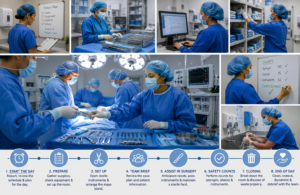
A surgical technologist student prepares sterile instruments during clinical training in a modern operating room.
Quick Answer
To become a surgical technologist, you must earn a high school diploma or GED and graduate from an accredited surgical technology program. Most students complete a certificate, diploma, or associate degree in 9–24 months, followed by supervised clinical training and national certification. Many employers prefer graduates who earn the Certified Surgical Technologist (CST) credential through the National Board of Surgical Technology and Surgical Assisting (NBSTSA).
Key Takeaways
✔ A high school diploma or GED is the minimum education requirement.
✔ Accredited surgical technology programs usually take 9–24 months to complete.
✔ CAAHEP and ABHES accreditation improve certification eligibility and employment opportunities.
✔ Students complete classroom instruction, simulation labs, and supervised clinical rotations.
✔ Most accredited programs require participation in approximately 120 surgical cases before graduation.
✔ The CST certification is the credential most hospitals prefer.
✔ Continuing education is required to maintain certification.
Introduction
A surgical technologist prepares operating rooms, maintains sterile technique, manages surgical instruments, and supports surgeons before, during, and after surgical procedures. Because patient safety depends on precision and infection control, employers expect graduates to complete structured education and clinical training before entering the operating room.
According to the U.S. Bureau of Labor Statistics (BLS), employment for surgical technologists is projected to grow over the coming years as healthcare systems perform more surgical procedures and expand outpatient services. This demand makes surgical technology one of the fastest-growing allied health careers.
Not every educational pathway leads to the same career opportunities. Many hospitals prefer applicants who graduate from CAAHEP-accredited or ABHES-accredited programs because these programs meet nationally recognized educational standards and prepare students for professional certification.
Choosing the right program affects:
- Certification eligibility
- Employment opportunities
- Financial aid eligibility
- Credit transfer options
- Long-term career advancement
This guide explains every stage of becoming a surgical technologist, including admission requirements, accredited education pathways, clinical training, certification, licensing requirements, tuition costs, and the timeline from high school to your first job.
Who Can Become a Surgical Technologist?
Most surgical technology programs accept applicants who have a high school diploma or GED, meet health and background screening requirements, and demonstrate the physical and professional skills needed to work safely in an operating room.
Although admission requirements vary by institution, accredited programs evaluate both academic qualifications and professional readiness before admitting students.
Minimum Eligibility Requirements
Most accredited programs require applicants to meet the following criteria.
| Requirement | Typical Requirement |
|---|---|
| Education | High school diploma or GED |
| Age | Usually 17–18 years or older |
| Criminal Background Check | Required before clinical placement |
| Drug Screening | Required by most hospitals |
| Immunizations | Required before clinical rotations |
| CPR/BLS Certification | Required by many programs |
| Physical Examination | Often required |
| TB Testing | Required by clinical facilities |
Hospitals establish many of these requirements because students work directly with patients during clinical education.
What Skills Does a Surgical Technologist Need?
Successful surgical technologists combine medical knowledge with technical ability and professional behavior.
Physical Skills
A surgical technologist must:
- Stand for several hours during surgery.
- Lift and reposition patients when necessary.
- Maintain fine motor control while handling delicate surgical instruments.
- Work efficiently in fast-paced operating rooms.
Cognitive Skills
Students develop critical thinking throughout their education because surgical procedures can change unexpectedly.
Important cognitive skills include:
- Problem solving
- Situational awareness
- Attention to detail
- Clinical decision support
- Instrument recognition
- Surgical procedure sequencing
A skilled surgical technologist anticipates the surgeon’s next instrument instead of waiting for verbal instructions.
Communication Skills
Operating rooms depend on teamwork.
Surgical technologists communicate continuously with:
- Surgeons
- Registered nurses
- Surgical assistants
- Certified Registered Nurse Anesthetists (CRNAs)
- Anesthesiologists
- Sterile processing departments
Clear communication reduces delays and helps prevent preventable surgical errors.
Professional Qualities
Healthcare employers also evaluate professional behavior.
Successful students consistently demonstrate:
- Reliability
- Professional ethics
- Time management
- Emotional stability
- Patient confidentiality
- Accountability
- Adaptability
These qualities become especially important during clinical rotations, where instructors assess technical performance and workplace professionalism.
Health and Clinical Requirements
Why Do Surgical Technology Programs Require Health Screenings?
Clinical education places students inside hospitals and ambulatory surgery centers. Healthcare facilities require health documentation to protect patients, staff, and students from preventable infectious diseases.
Most schools require:
- Hepatitis B vaccination
- MMR vaccination
- Varicella vaccination
- Influenza vaccination
- COVID-19 vaccination (where required by clinical partners)
- Tuberculosis screening
- Physical examination
Clinical partners may require additional documentation depending on hospital policies.
Why Are Background Checks and Drug Tests Required?
Hospitals conduct criminal background checks and drug screening because surgical technologists have direct access to patients, medications, sterile supplies, and restricted clinical environments.
Most students complete these screenings before beginning clinical rotations.
Failure to meet clinical site requirements may delay graduation because students cannot complete mandatory clinical hours.
Is Surgical Technology the Right Career for You?
Surgical technology is suitable for people who enjoy structured medical environments, precision, teamwork, and hands-on patient care.
You may be a good fit if you enjoy:
- Science
- Human anatomy
- Healthcare technology
- Working under pressure
- Following standardized procedures
- Maintaining sterile environments
- Supporting surgical teams
People who dislike fast-paced environments or prolonged standing may find operating room work challenging.
High School Preparation: Build the Right Foundation Before Enrolling
Taking science and healthcare-related subjects in high school gives you a stronger foundation for surgical technology programs. Biology, anatomy, chemistry, communication, and mathematics help students understand surgical procedures, sterile technique, and patient care more easily.
Although most accredited programs only require a high school diploma or GED, students who build these skills before applying often perform better in prerequisite courses and clinical training.
Which High School Subjects Are Best for Future Surgical Technologists?
The right coursework prepares students for anatomy-heavy college classes and develops scientific thinking.
| Subject | Why It Matters |
|---|---|
| Biology | Explains cells, tissues, organs, and body systems. |
| Human Anatomy | Introduces body structures used during surgery. |
| Physiology | Explains how organs function before, during, and after surgery. |
| Chemistry | Supports pharmacology and sterilization concepts. |
| Microbiology | Helps students understand infection prevention and pathogens. |
| Mathematics | Develops measurement and dosage calculation skills. |
| English | Improves documentation and communication. |
| Computer Applications | Prepares students for electronic health records (EHRs). |
| Health Science | Introduces healthcare terminology and patient care fundamentals. |
Students without anatomy or biology can still succeed, but these subjects reduce the learning curve during the first semester.
Which Soft Skills Improve Success?
Technical knowledge alone is not enough. Surgical technologists work in high-pressure operating rooms where teamwork and precision directly affect patient safety.
Develop these skills early:
- Communicate clearly with others.
- Follow detailed instructions accurately.
- Stay organized under pressure.
- Solve problems quickly.
- Manage time effectively.
- Maintain attention to detail.
- Adapt to unexpected situations.
- Work confidently as part of a team.
Clinical instructors frequently evaluate professionalism as closely as technical ability.
What Extracurricular Activities Strengthen Your Application?
Healthcare experience helps students understand hospital environments before formal training begins.
Recommended activities include:
- Hospital volunteering
- HOSA (Health Occupations Students of America)
- CPR or Basic Life Support (BLS) certification
- Job shadowing a surgical technologist
- Volunteering in healthcare settings
- Science fairs
- Anatomy clubs
- Community health programs
Even a few hours of job shadowing can provide realistic insight into operating room responsibilities.
Should You Earn CPR Certification Before Applying?
Yes. Many surgical technology programs require Basic Life Support (BLS) certification before clinical rotations begin.
The American Heart Association (AHA) BLS course teaches:
- Adult CPR
- Child CPR
- Infant CPR
- AED operation
- Emergency response
- Team-based resuscitation
Completing BLS certification early removes one admission requirement and demonstrates commitment to healthcare.
Understanding Surgical Technologist Education Pathways
Students can become surgical technologists through certificate, diploma, associate degree, military, bridge, accelerated, or hybrid programs. The best option depends on career goals, budget, and the amount of time available for education.
Every pathway should be evaluated based on accreditation rather than speed alone.
Education Pathways Compared
| Pathway | Typical Duration | Best For | Certification Eligibility |
|---|---|---|---|
| Certificate | 9–12 months | Fast workforce entry | Yes, if accredited |
| Diploma | 12–18 months | Career-focused education | Yes |
| Associate Degree | 18–24 months | Long-term advancement | Yes |
| Military Program | Varies | Military personnel | Often eligible |
| Bridge Program | 6–12 months | Current healthcare workers | Yes |
| Accelerated Program | 7–10 months | Full-time students | Yes |
| Hybrid Program | 12–18 months | Flexible scheduling | Yes |
| Online Didactic Program | 12–24 months | Distance learners | Clinical training remains in person |
Regardless of delivery format, accredited programs require students to complete supervised clinical education in approved healthcare facilities.
Certificate vs Diploma vs Associate Degree
A certificate provides the fastest route into the profession, while an associate degree offers broader education, transferable college credits, and stronger long-term career flexibility.
Comparison Table
| Feature | Certificate | Diploma | Associate Degree |
|---|---|---|---|
| Program Length | 9–12 Months | 12–18 Months | 18–24 Months |
| General Education | Minimal | Limited | Extensive |
| Clinical Training | Required | Required | Required |
| Accreditation Available | Yes | Yes | Yes |
| CST Eligibility | Yes | Yes | Yes |
| Tuition | Lower | Moderate | Higher |
| Transfer Credits | Limited | Some | High |
| Career Advancement | Good | Good | Excellent |
Which Option Is Best?
Certificate
Best for students who want to begin working quickly.
Advantages
- Lower tuition
- Short completion time
- Earlier entry into the workforce
Limitations
- Limited transferable credits
- Fewer general education courses
Diploma
Best for students seeking balanced technical education.
Advantages
- Moderate completion time
- Strong technical training
- Certification eligibility
Limitations
Credit transfer depends on the institution
Associate Degree
Best for students planning long-term healthcare careers.
Advantages
- Greater academic depth
- Easier transfer into bachelor’s programs
- Better preparation for leadership roles
Strong pathway toward nursing, physician assistant, healthcare administration, or surgical first assisting
Limitations
- Higher tuition
- Longer completion time
Does Your Degree Affect Salary?
Education alone does not determine salary.
Salary depends on multiple factors, including:
- Geographic location
- Years of experience
- Employer type
- Surgical specialty
- Certification status
- Shift differentials
- Overtime availability
However, associate degree graduates often qualify for supervisory roles and advanced education more easily, which may increase long-term earning potential.
Can You Complete Surgical Technology School Online?
Partially.
Many accredited programs allow students to complete lecture-based coursework online.
Clinical education cannot be completed remotely.
Students must perform hands-on training in hospitals or surgical centers because accreditation standards require direct patient care experience under instructor supervision.
Programs advertising fully online surgical technology education without in-person clinical training should be evaluated carefully to ensure they meet accreditation standards.
Expert Insight
Many applicants choose the shortest program because they want to start working sooner. A better strategy is to compare accreditation status, certification pass rates, clinical partnerships, graduation rates, job placement rates, and employer reputation before comparing tuition or program length. Graduates from strong accredited programs often have better employment outcomes than graduates from faster but lower-quality programs.
Sources
- U.S. Bureau of Labor Statistics (BLS)
- Commission on Accreditation of Allied Health Education Programs (CAAHEP)
- Accreditation Review Council on Education in Surgical Technology and Surgical Assisting (ARC/STSA)
- Association of Surgical Technologists (AST)
- National Board of Surgical Technology and Surgical Assisting (NBSTSA)
How to Choose the Right Surgical Technology Program
Choose an accredited surgical technology program with strong certification pass rates, quality clinical partnerships, experienced faculty, and high graduate employment rates. Accreditation, not tuition or program length, has the greatest impact on your career opportunities.
Many students compare only tuition costs. Employers, however, evaluate where you trained, whether your program meets national accreditation standards, and whether you qualify for professional certification.
Why Does Choosing the Right Program Matter?
The quality of your education influences far more than graduation.
A strong program improves:
- Certification eligibility
- Clinical experience
- Job placement opportunities
- Financial aid eligibility
- Transferable college credits
- Career advancement
- Employer confidence
A poor-quality program may delay certification or reduce employment opportunities, even after graduation.
What Should You Compare Before Enrolling?
Before applying, compare every program using objective criteria rather than marketing claims.
| Evaluation Factor | Why It Matters |
|---|---|
| Accreditation | Determines certification eligibility and educational quality. |
| Certification Pass Rate | Reflects how well graduates perform on national exams. |
| Graduation Rate | Indicates student success and program support. |
| Job Placement Rate | Shows how many graduates secure employment. |
| Clinical Affiliations | Provide hands-on surgical experience. |
| Faculty Experience | Experienced instructors teach practical operating room skills. |
| Simulation Laboratory | Improves confidence before clinical rotations. |
| Student-to-Faculty Ratio | Smaller classes provide more individualized instruction. |
| Tuition and Fees | Determines overall educational cost. |
| Financial Aid Availability | Reduces out-of-pocket expenses. |
| Employer Reputation | Strong programs are recognized by local hospitals. |
Students should request these statistics directly from admissions offices instead of relying only on promotional materials.
Accreditation Is the First Thing to Verify
Accreditation confirms that a program meets nationally recognized educational standards.
Without proper accreditation, graduates may not qualify for certification exams or financial aid.
The two primary accrediting organizations are:
- CAAHEP (Commission on Accreditation of Allied Health Education Programs)
- ABHES (Accrediting Bureau of Health Education Schools)
Most hospitals prefer graduates from accredited programs because these schools follow standardized curriculum requirements.
Why Are Clinical Partnerships Important?
Clinical education transforms classroom knowledge into professional skills.
Programs with multiple hospital partnerships usually provide:
- Greater exposure to surgical specialties
- More experienced preceptors
- Better learning environments
- Additional networking opportunities
- Increased employment prospects after graduation
Students should ask:
- Which hospitals serve as clinical sites?
- How many clinical partners does the program have?
- Will I rotate through multiple specialties?
- What percentage of students receive employment offers after clinical training?
Strong clinical experiences often lead directly to job interviews.
Should You Compare Certification Pass Rates?
Yes.
Certification pass rates indicate how effectively a program prepares students for national examinations.
Ask schools:
- What percentage of graduates pass the CST examination on the first attempt?
- What is the average pass rate over the past five years?
- What academic support is available for students preparing for certification?
Consistently high pass rates often reflect strong instruction and comprehensive curriculum design.
Why Does Faculty Experience Matter?
Experienced instructors contribute practical knowledge that textbooks cannot provide.
Faculty members with operating room experience teach students how to:
- Maintain sterile technique
- Anticipate surgeon needs
- Handle surgical instruments efficiently
- Communicate during emergencies
- Solve real-world clinical problems
Learning from professionals who have worked in surgery helps bridge the gap between classroom instruction and clinical practice.
What Questions Should You Ask Before Applying?
Prepare questions before attending an admissions interview.
Examples include:
- Is the program accredited by CAAHEP or ABHES?
- What is the CST first-time pass rate?
- How many surgical cases do students complete?
- Which hospitals provide clinical training?
- What financial aid options are available?
- Are evening or hybrid classes offered?
- What percentage of graduates find employment within six months?
- Does the program provide career placement assistance?
Clear answers help you compare programs objectively.
Accreditation Explained
Accreditation verifies that a surgical technology program meets national educational standards. Graduating from an accredited program is the most common pathway to certification and employment.
Many employers consider accreditation a minimum hiring requirement.
What Is CAAHEP?
CAAHEP (Commission on Accreditation of Allied Health Education Programs) is the primary accrediting organization for surgical technology education in the United States.
CAAHEP evaluates programs based on:
- Curriculum quality
- Faculty qualifications
- Clinical education
- Student outcomes
- Institutional resources
- Continuous program improvement
Programs must maintain these standards to remain accredited.
What Is ARC/STSA?
The Accreditation Review Council on Education in Surgical Technology and Surgical Assisting (ARC/STSA) reviews surgical technology programs and makes accreditation recommendations to CAAHEP.
ARC/STSA evaluates:
- Curriculum compliance
- Clinical case requirements
- Faculty credentials
- Student competency
- Program outcomes
Together, ARC/STSA and CAAHEP help ensure consistent educational quality nationwide.
What Is ABHES?
The Accrediting Bureau of Health Education Schools (ABHES) accredits many private and career-focused healthcare institutions.
ABHES accreditation also supports eligibility for certification pathways, provided other certification requirements are met.
Students should confirm certification eligibility directly with the certifying organization before enrolling.
Why Do Employers Prefer Accredited Graduates?
Hospitals invest significant resources in onboarding new employees.
Graduates from accredited programs typically receive standardized education in:
- Sterile processing
- Infection prevention
- Surgical instrumentation
- Patient safety
- Surgical procedures
- Professional ethics
This consistency reduces training time and improves patient safety.
Accreditation Benefits
| Benefit | Why It Matters |
|---|---|
| Certification Eligibility | Required by many national certification pathways. |
| Federal Financial Aid | Accredited schools generally qualify for FAFSA funding. |
| Employer Recognition | Hospitals commonly prefer accredited graduates. |
| Credit Transfer | Accredited coursework transfers more easily. |
| Educational Quality | Curriculum follows national standards. |
| Career Mobility | Accreditation supports future education and advancement. |
Common Mistakes When Choosing a Program
Avoid these common errors:
- Choosing the lowest tuition without checking accreditation.
- Ignoring certification pass rates.
- Failing to visit the simulation laboratory.
- Not asking about clinical placements.
- Assuming every online program offers equivalent education.
- Overlooking graduate employment statistics.
- Enrolling before confirming financial aid eligibility.
These mistakes can affect certification, employment, and long-term career growth.
Admission Requirements for Surgical Technology Programs
Most accredited surgical technology programs require a high school diploma or GED, prerequisite science courses, health screenings, a criminal background check, drug screening, CPR certification, and documentation required by clinical training sites.
Admission requirements vary by institution, but accredited programs follow similar standards because students participate in direct patient care during clinical education.
Standard Admission Requirements
The following table summarizes the most common admission requirements.
| Requirement | Typical Requirement | Why It Matters |
|---|---|---|
| High School Diploma or GED | Required | Demonstrates minimum educational qualification |
| Minimum GPA | Usually 2.0–2.5 | Confirms academic readiness |
| Biology or Anatomy | Required or Recommended | Builds scientific foundation |
| Criminal Background Check | Required | Meets hospital policies |
| Drug Screening | Required | Ensures patient safety |
| Physical Examination | Required | Confirms ability to complete clinical duties |
| Immunization Records | Required | Prevents disease transmission |
| TB Screening | Required | Meets infection-control standards |
| CPR/BLS Certification | Required by many programs | Prepares students for emergencies |
| Health Insurance | Often Required | Covers clinical participation |
| Personal Statement | Sometimes Required | Evaluates motivation and communication skills |
| Letters of Recommendation | Varies | Supports application review |
| Interview | Required by some schools | Assesses professionalism and communication |
Students should verify admission policies directly with the institution because individual requirements may differ.
What GPA Do You Need?
Most surgical technology programs require a minimum GPA between 2.0 and 2.5, although competitive programs may expect a higher GPA.
Applicants with stronger academic records often have an advantage when programs receive more applications than available seats.
Courses that typically influence admission include:
- Biology
- Anatomy
- Physiology
- Chemistry
- Medical Terminology
Strong grades in science subjects demonstrate readiness for healthcare education.
Are Entrance Exams Required?
Most surgical technology programs do not require ACT or SAT scores.
Some colleges may require placement testing such as:
- TEAS (Test of Essential Academic Skills)
- ACCUPLACER
- Institution-specific placement assessments
These exams evaluate reading, mathematics, and science knowledge before enrollment.
Why Are Health Screenings Required?
Hospitals require students to complete health screenings before participating in clinical education.
These screenings reduce the risk of transmitting infectious diseases to patients and healthcare workers.
Most programs require documentation for:
- Hepatitis B
- Measles, Mumps, Rubella (MMR)
- Varicella
- Influenza
- Tuberculosis screening
- COVID-19 vaccination (when required by clinical partners)
Clinical facilities may request additional vaccinations based on local policies.
Why Are Background Checks Required?
Operating rooms contain controlled medications, confidential patient information, and restricted clinical environments.
Healthcare facilities conduct criminal background checks to:
- Protect patients
- Meet regulatory requirements
- Maintain workplace safety
- Comply with hospital credentialing policies
Certain criminal convictions may affect eligibility for clinical placement.
Students should review institutional policies before applying.
Why Are Drug Tests Required?
Drug screening helps hospitals maintain a safe clinical environment.
Most students complete drug testing:
- Before clinical rotations
- Before employment
- When required by hospital policy
A failed drug screen can delay clinical placement or program completion.
What Makes an Applicant More Competitive?
Meeting minimum admission requirements does not guarantee acceptance.
Applicants strengthen their applications by:
- Earning high science grades
- Completing CPR/BLS certification early
- Volunteering in hospitals
- Shadowing a surgical technologist
- Participating in HOSA
- Demonstrating professional communication skills
- Submitting strong recommendation letters
Healthcare experience also helps applicants understand operating room expectations before beginning training.
Prerequisite Courses
Prerequisite courses prepare students for anatomy, pharmacology, microbiology, and surgical procedures. These subjects establish the scientific knowledge required for safe patient care.
- Common Prerequisite Courses
- Course Purpose
- Biology Introduces living systems and cell biology
- Human Anatomy Explains body structures
- Human Physiology Explains organ function
- Chemistry Supports pharmacology and sterilization concepts
- Microbiology Covers microorganisms and infection prevention
- Medical Terminology Develops healthcare vocabulary
- English Composition Improves written communication
- Psychology Introduces patient behavior
- Communication Strengthens teamwork
- College Algebra Supports dosage calculations
Many programs include some prerequisite courses during the first semester rather than requiring them before admission.
Why Is Medical Terminology Important?
Medical terminology allows surgical teams to communicate accurately during procedures.
Students learn terminology related to:
- Surgical instruments
- Anatomy
- Surgical procedures
- Pathology
- Pharmacology
- Diagnostic testing
Understanding medical language improves communication and reduces clinical errors.
Curriculum Overview
Surgical technology programs combine classroom instruction, laboratory practice, and supervised clinical education to prepare students for operating room responsibilities.
The curriculum progresses from foundational sciences to advanced perioperative care.
Typical Curriculum
- Semester Major Topics
- Semester 1 Medical Terminology, Anatomy, Physiology, Introduction to Surgical Technology
- Semester 2 Microbiology, Pharmacology, Sterile Technique, Surgical Instrumentation
- Semester 3 Surgical Procedures, Patient Care, Surgical Specialties
- Semester 4 Clinical Practicum, Professional Ethics, Legal Issues, Capstone
Program length varies depending on whether students pursue a certificate, diploma, or associate degree.
Core Subjects Students Study
Students commonly learn:
- Human anatomy
- Human physiology
- Pathophysiology
- Pharmacology
- Surgical instrumentation
- Sterile processing
- Infection prevention
- Surgical procedures
- Operating room management
- Medical ethics
- Patient safety
- Healthcare law
These subjects prepare graduates for both certification examinations and clinical practice.
Skills Laboratory Training
Simulation laboratories allow students to practice essential surgical skills before working with patients.
Students repeat procedures until they demonstrate competency under instructor supervision.
Skills Practiced in Simulation Labs
Students develop proficiency in:
- Surgical hand scrubbing
- Sterile gowning
- Closed and open gloving
- Sterile field setup
- Instrument identification
- Instrument passing
- Surgical counts
- Suturing techniques
- Surgical draping
- Electrosurgical equipment
- Specimen handling
- Sterile technique maintenance
Simulation reduces mistakes before students enter live operating rooms.
Why Is Simulation Training Important?
Simulation improves:
- Technical confidence
- Hand-eye coordination
- Instrument familiarity
- Team communication
- Patient safety
- Clinical decision-making
Students who master simulation skills usually transition more smoothly into clinical rotations.
Clinical Education
Clinical education provides supervised operating room experience where students apply classroom knowledge during real surgical procedures.
Clinical training is a mandatory requirement for graduation from accredited surgical technology programs.
What Happens During Clinical Rotations?
Students gradually assume greater responsibility while supervised by experienced surgical technologists and instructors.
Clinical responsibilities include:
- Preparing operating rooms
- Creating sterile fields
- Organizing surgical instruments
- Assisting with patient positioning
- Passing instruments
- Maintaining sterile technique
- Performing sponge, needle, and instrument counts
- Handling surgical specimens
- Supporting the surgical team
Each rotation develops technical competence and professional confidence.
Common Clinical Training Sites
Students may complete rotations in:
- Community hospitals
- Teaching hospitals
- Trauma centers
- Ambulatory surgery centers
- Specialty surgical hospitals
- Veterans Affairs (VA) medical centers
Exposure to different healthcare settings broadens surgical experience.
Surgical Case Requirements
Accredited surgical technology programs require students to complete supervised surgical cases before graduation. Clinical case requirements verify that students can apply sterile technique, surgical instrumentation, patient safety principles, and teamwork in real operating rooms.
According to ARC/STSA Standards, students must demonstrate competency across multiple surgical specialties before becoming eligible for graduation.
Why Are Surgical Cases Required?
Classroom instruction teaches theory.
Clinical cases demonstrate competency.
Every student must prove they can:
- Prepare the operating room.
- Maintain a sterile field.
- Identify surgical instruments.
- Anticipate surgeon needs.
- Perform surgical counts.
- Communicate with the surgical team.
- Protect patient safety throughout the procedure.
These competencies cannot be evaluated through written examinations alone.
Typical Surgical Specialties
Students rotate through multiple specialties because each procedure uses different instruments, techniques, and patient positioning.
- Surgical Specialty Typical Learning Focus
- General Surgery Basic instrumentation and sterile technique
- Orthopedic Surgery Bone instruments, implants, power equipment
- Neurosurgery Microsurgical instruments and delicate tissue handling
- Cardiovascular Surgery Cardiac instrumentation and sterile precision
- Obstetrics & Gynecology Women’s surgical procedures
- ENT Microsurgery and specialized instrumentation
- Plastic Surgery Fine tissue handling and cosmetic procedures
- Pediatric Surgery Pediatric anatomy and patient safety
- Ophthalmology Microsurgical visualization and precision
- Urology Endoscopic and minimally invasive procedures
Exposure varies depending on clinical site availability.
The 120 Surgical Case Requirement
Most CAAHEP-accredited programs require students to complete approximately 120 supervised surgical cases, following ARC/STSA clinical standards.
These cases generally include:
- First Scrub Role
- Second Scrub Role
- Multiple surgical specialtiesIncreasing levels of responsibility
Students gradually move from observation to independent participation under instructor supervision.
What Is the First Scrub Role?
During the first scrub role, students actively function as members of the sterile surgical team.
Responsibilities include:
- Preparing sterile instruments
- Passing instruments
- Maintaining sterile technique
- Organizing supplies
- Performing surgical counts
- Assisting throughout the operation
Students must demonstrate competency before instructors approve independent participation.
What Is the Second Scrub Role?
Second scrub experience provides additional learning while sharing responsibilities with another scrub person.
Students continue developing:
- Instrument recognition
- Procedure sequencing
- Communication skills
- Operating room workflow
- Surgical anticipation
This progression builds confidence before independent practice.
Graduation Requirements
Graduation requires successful completion of academic coursework, laboratory competencies, clinical education, required surgical cases, and professional behavior standards.
Meeting only classroom requirements is not sufficient.
Academic Requirements
Students generally must:
- Pass every required course.
- Maintain the minimum GPA.
- Complete laboratory evaluations.
- Demonstrate competency in practical examinations.
Schools establish specific GPA policies based on institutional requirements.
Clinical Requirements
Graduates must complete:
- Required clinical hours
- Surgical case requirements
- Skills competency evaluations
- Clinical instructor assessments
- Professional conduct evaluations
Clinical performance carries significant weight because employers expect graduates to enter the workforce with practical experience.
Professional Standards
Students are also evaluated on workplace behavior.
Programs assess:
- Attendance
- Punctuality
- Communication
- Teamwork
- Ethical behavior
- Patient confidentiality
- Professional appearance
- Accountability
Professionalism often influences instructor recommendations and future employment opportunities.
National Certification
After graduation, many students pursue national certification to demonstrate professional competency and improve employment opportunities.
The two primary certifications are:
- Certified Surgical Technologist (CST)
- Tech in Surgery – Certified (TS-C)
- CST vs TS-C
- Feature CST TS-C
- Certifying Organization NBSTSA NCCT
- Preferred by Hospitals Yes Accepted by many employers
- Primary Eligibility Accredited program graduate Multiple eligibility pathways
- Examination National Certification Exam National Certification Exam
- Renewal Continuing Education or Examination Continuing Education or Renewal Requirements
Many employers list the CST credential as the preferred certification because it aligns closely with accredited educational standards.
Why Does Certification Matter?
Certification demonstrates that graduates meet nationally recognized competency standards.
Benefits include:
- Greater employment opportunities
- Higher employer confidence
- Improved career mobility
- Professional credibility
- Competitive job applications
- Easier career advancement
Although some states do not legally require certification, many hospitals require it for employment.
Continuing Education Requirements
Professional learning continues after certification.
Continuing education helps surgical technologists remain current with:
- Infection prevention
- Surgical technology
- Patient safety standards
- New surgical equipment
- Updated professional guidelines
Maintaining certification demonstrates ongoing professional competence.
State Licensing Requirements
State regulation varies across the United States.
Some states regulate surgical technologists through certification or registration requirements.
Others leave employment decisions to individual healthcare employers.
Students should always verify current regulations with their state’s health department or professional licensing authority before graduation.
Military and Alternative Pathways
Several alternative pathways exist for qualified individuals.
These include:
- Military medical training
- Healthcare bridge programs
- Career transition programs
- Previous operating room experience (where accepted)
- International credential evaluation
Eligibility depends on certification organization requirements.
Cost of Becoming a Surgical Technologist
Education costs vary depending on program type, institution, and geographic location.
Students should budget for more than tuition.
- Typical Educational Expenses
- Expense Typical Cost Category
- Tuition Largest Expense
- Books Moderate
- Uniforms and Scrubs Moderate
- Background Check Required
- Drug Screening Required
- Immunizations Required
- Liability Insurance Often Required
- CPR Certification Usually Required
- Certification Examination Additional Cost
- Clinical Travel Variable
- Living Expenses Variable
Students should request a complete cost breakdown before enrolling.
Financial Aid Options
Many accredited institutions participate in federal financial aid programs.
Potential funding includes:
- FAFSA
- Pell Grants (eligible students)
- Institutional scholarships
- Workforce development grants
- Veteran education benefits
- Employer tuition assistance
Students should submit financial aid applications early because some funding is limited.
Timeline: From High School to Employment
Most students complete the following pathway:
- Graduate from high school or earn a GED.
- Complete prerequisite requirements.
- Enroll in an accredited surgical technology program.
- Complete classroom education.
- Complete simulation laboratory training.
- Complete clinical rotations.
- Graduate.
- Pass the national certification examination.
- Apply for employment.
- Complete continuing education throughout your career.
Most students enter the workforce within 9–24 months, depending on their educational pathway.
Common Mistakes Students Make
Avoid these mistakes:
- Choosing a non-accredited school.
- Ignoring certification requirements.
- Waiting too long to apply for financial aid.
- Missing clinical deadlines.
- Poor attendance during clinical rotations.
- Weak anatomy preparation.
- Underestimating medical terminology.
- Not practicing sterile technique outside laboratory sessions.
- Failing to prepare for certification exams.
Tips for Success
Successful students consistently:
- Study anatomy every week.
- Review medical terminology daily.
- Practice sterile technique repeatedly.
- Ask instructors for feedback.
- Prepare before every clinical day.
- Build professional relationships during clinical rotations.
- Stay organized.
- Develop communication skills.
- Prioritize patient safety over speed.
Employers consistently value professionalism, reliability, and teamwork alongside technical ability.
FAQs
Can I become a surgical technologist without college?
No. You must complete an accredited certificate, diploma, or associate degree program before qualifying for most certification pathways.
Can I work while attending school?
Many students work part-time during classroom instruction. Clinical rotations usually require daytime availability, making full-time employment more difficult.
Is online surgical technology education accepted?
Lecture-based coursework may be completed online. Clinical education must be completed in approved healthcare facilities.
What is the fastest way to become a surgical technologist?
An accredited certificate program typically provides the shortest pathway, often completed within 9–12 months.
Do all hospitals require certification?
Requirements vary by employer. Many hospitals strongly prefer or require CST certification even in states without licensing laws.
Is surgical technology physically demanding?
Yes. Surgical technologists often stand for long periods, move equipment, maintain concentration, and work in fast-paced operating rooms.
Can I specialize after becoming a surgical technologist?
Yes. Experienced professionals may specialize in cardiovascular, orthopedic, neurosurgery, transplant surgery, robotic surgery, labor and delivery, or surgical first assisting.
Can I advance my career later?
Yes. Many surgical technologists continue into healthcare leadership, education, surgical assisting, nursing, physician assistant programs, or healthcare administration.
Final Thoughts
Becoming a surgical technologist involves more than completing a training program. Success depends on choosing an accredited institution, mastering sterile technique, developing strong clinical judgment, and earning professional certification recognized by employers.
Students who invest in high-quality education, practical experience, and lifelong learning are better prepared to adapt to evolving surgical practices and contribute to safe patient care. As healthcare technology advances and surgical procedures become more specialized, maintaining current knowledge through continuing education and professional development remains an essential part of a successful surgical technology career.
Medical Disclaimer
The information provided in this article is for educational and informational purposes only and should not be considered medical, legal, or career advice. While every effort has been made to ensure the accuracy of the information, admission requirements, certification eligibility, licensing regulations, and educational standards may change over time and can vary by state, institution, or employer.
Prospective students should verify the latest requirements directly with accredited organizations such as the Commission on Accreditation of Allied Health Education Programs (CAAHEP), the Accreditation Review Council on Education in Surgical Technology and Surgical Assisting (ARC/STSA), the National Board of Surgical Technology and Surgical Assisting (NBSTSA), the National Center for Competency Testing (NCCT), and their chosen educational institution.