
Surgical Tech vs Scrub Nurse: Key Differences, Roles, Training, Salary, and Career Path Guide
surgical-tech-vs-scrub-nurse
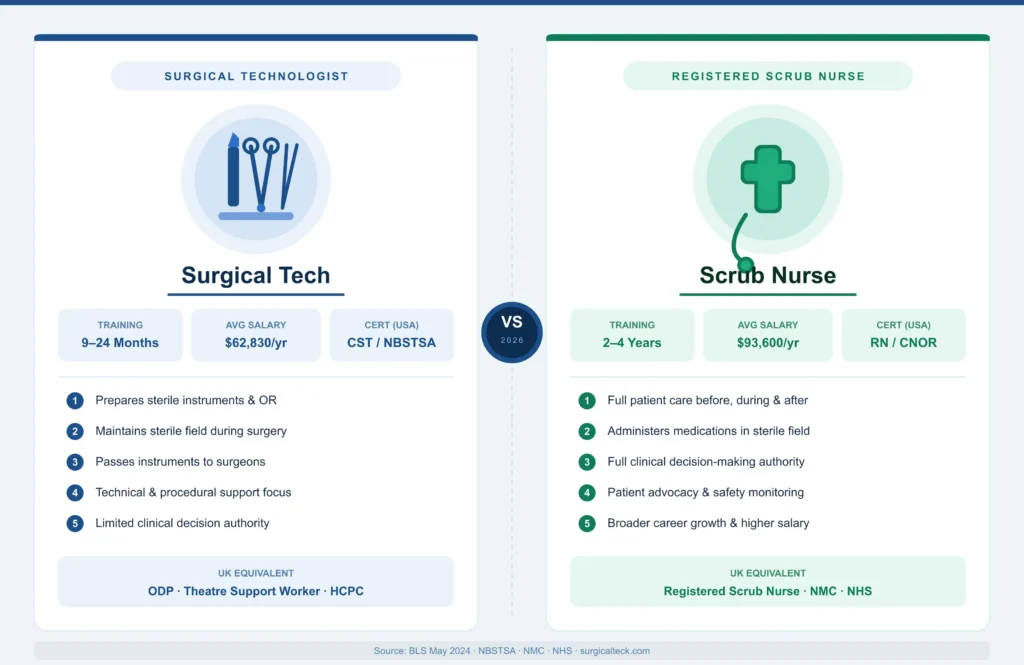
Quick Answer: A Surgical Tech prepares operating rooms, sterilizes instruments, and assists surgeons with equipment. A Scrub Nurse is a registered nurse who manages patient care before, during, and after surgery while assisting the surgical team. Training, licensing, responsibilities, and career progression differ significantly in both the USA and UK.
Introduction
If you are exploring a career in perioperative care, you have likely come across two roles that seem very similar: the Surgical Technologist and the Scrub Nurse. Both professionals work inside the operating room, assist during surgeries, and play critical roles in patient safety — yet their education, responsibilities, clinical authority, and career pathways are very different.
Many students and career changers confuse these two roles because both involve scrubbing in for surgeries and handling sterile instruments. However, a Scrub Nurse is a Registered Nurse (RN) with full clinical decision-making authority, while a Surgical Technologist focuses primarily on procedural and technical support.
This guide breaks down every key difference between a Surgical Tech and a Scrub Nurse for both the USA and UK healthcare systems, including education requirements, certification, salary data, daily duties, and career growth paths.
What Is a Surgical Tech?
A Surgical Technologist — also called a Surgical Tech, Surgical Technician, or Operating Room Technician — supports surgical procedures by preparing instruments, maintaining sterile environments, and assisting surgeons during operations.
In the USA, the role is defined and certified by the National Board of Surgical Technology and Surgical Assisting (NBSTSA) through the Certified Surgical Technologist (CST) credential. In the UK, equivalent support roles fall under Theatre Support Worker, Operating Department Practitioner (ODP), or Surgical Care Practitioner categories.
Core Duties of a Surgical Tech
- Prepare and organize sterile surgical instruments before each procedure
- Set up and test surgical equipment and supplies
- Maintain the sterile field throughout the operation
- Pass instruments and supplies to surgeons during procedures
- Count surgical tools, sponges, and needles before and after surgery
- Assist with patient positioning and draping
- Handle and label surgical specimens
- Restock and clean the operating room after each case
What Is a Scrub Nurse?
A Scrub Nurse is a Registered Nurse (RN) who has specialized in perioperative care. Unlike a Surgical Tech, a Scrub Nurse holds full nursing licensure and has the clinical authority to make patient care decisions, administer medications, and advocate directly for the patient throughout the surgical experience.
In the USA, Scrub Nurses typically hold an Associate Degree in Nursing (ADN) or a Bachelor of Science in Nursing (BSN), have passed the NCLEX-RN licensing examination, and may hold specialty certifications such as the CNOR (Certified Nurse Operating Room). In the UK, Scrub Nurses are Registered Nurses registered with the Nursing and Midwifery Council (NMC) who have completed specialized theatre training through NHS pathways.
Core Duties of a Scrub Nurse
- Verify patient identity, records, and surgical consent before procedures
- Review patient history and identify risk factors
- Confirm surgical site, procedure details, and implants
- Maintain sterility and assist the surgical team during operations
- Monitor patient status and communicate with anaesthesia teams
- Administer or verify medications within the surgical field
- Document intraoperative care and safety checks
- Coordinate post-operative handover to recovery teams
Surgical Tech vs Scrub Nurse: Quick Comparison Table
| Feature | Surgical Tech | Scrub Nurse |
|---|---|---|
| Education | Diploma / Associate Degree | ADN or BSN (Nursing Degree) |
| License Required | Varies by state | RN Registration required |
| Patient Care Authority | Limited | Extensive clinical authority |
| Surgical Assistance | High | High |
| Medication Administration | No | Yes |
| Clinical Decision Making | Limited | Full clinical authority |
| USA Certification | CST (NBSTSA) | RN / CNOR |
| UK Equivalent | ODP / Theatre Support | Registered Scrub Nurse (NMC) |
| Career Growth | Moderate | Broad and advanced |
| Average USA Salary | $55,000 – $75,000+ | $70,000 – $100,000+ |
| Training Duration | 9–24 months | 2–4 years |
What Does a Surgical Tech Do Daily?
Before Surgery: Operating Room Preparation
The surgical day begins long before the first patient enters the OR. A Surgical Tech arrives early to:
- Review the surgical schedule and pull the correct instrument sets
- Arrange and organize sterile instruments on the back table
- Test all equipment including electrosurgical units, suction, and retractors
- Set up draping and patient positioning supplies
- Perform an initial instrument, sponge, and needle count with the circulating nurse
During Surgery: Intraoperative Support
Once the operation begins, the Surgical Tech scrubs in and becomes a direct member of the sterile team:
- Passes instruments and supplies to surgeons on demand
- Anticipates surgical needs based on procedure knowledge
- Maintains the sterile field and reports any breaks in sterility
- Tracks all instruments and supplies throughout the procedure
- Handles and labels surgical specimens correctly
After Surgery: Post-Operative Duties
- Performs final instrument, sponge, and needle counts
- Assists with patient transfer and OR breakdown
- Cleans and decontaminates the surgical environment
- Restocks supplies and prepares for the next case
What Does a Scrub Nurse Do Daily?
Before Surgery: Pre-Operative Patient Support
Scrub Nurses engage directly with patients before surgery and hold clinical responsibilities that Surgical Techs do not:
- Verify patient identity using two-factor identification protocols
- Review the surgical consent form and confirm patient understanding
- Assess patient allergies, current medications, and medical history
- Ensure safety protocols including the WHO Surgical Safety Checklist are completed
- Communicate directly with patients to reduce pre-operative anxiety
During Surgery: Intraoperative Nursing Care
- Assist the surgeon while maintaining full clinical awareness of the patient
- Monitor patient condition and communicate changes to the anaesthetic team
- Administer or verify medications within the sterile field
- Coordinate team communication for patient safety decisions
- Document intraoperative events, counts, and care decisions in real time
After Surgery: Post-Operative Handover
- Complete formal documentation of the surgical procedure and care provided
- Communicate patient status and intraoperative events to recovery nurses
- Perform safety checks on instruments and patient condition
- Provide a structured clinical handover to the post-anaesthesia care unit (PACU)
Surgical Tech vs Scrub Nurse: Responsibilities Compared
Patient Care Responsibilities
The most important distinction between a Surgical Tech and a Scrub Nurse is the scope of patient care authority. Scrub Nurses are licensed clinicians who carry full nursing accountability for their actions. Surgical Techs perform technical and procedural support but do not hold independent clinical authority over patient care decisions. To understand the full scope of what surgical techs handle daily, see our detailed guide on key responsibilities of a surgical technologist.
Scrub Nurses can assess a patient’s condition and escalate concerns independently. Surgical Techs report observations through the nursing or surgical chain of command and do not act on clinical assessments independently.
Decision-Making Authority
In the surgical team hierarchy, the Scrub Nurse operates as a clinical professional with the authority to pause a procedure if patient safety is at risk. Surgical Technologists support this authority but do not hold it themselves. This distinction affects hiring requirements, legal accountability, and career advancement opportunities in both the USA and UK.
Educational Requirements in the USA
How to Become a Surgical Tech in the USA
Becoming a Surgical Technologist in the USA is generally faster and less expensive than becoming a nurse. The standard pathway includes:
- Complete a CAAHEP- or ABHES-accredited surgical technology program (9–24 months)
- Complete required clinical hours (approximately 300–400 supervised hours)
- Document approximately 120 surgical cases
- Pass the NBSTSA CST examination
- Apply for employment and pursue state registration where required
Program options include certificate programs (9–18 months) and Associate Degree programs (18–24 months). If you are wondering about the total investment involved, our surgical technologist school cost guide covers tuition, fees, and hidden expenses in detail. Military surgical training may also provide an alternative eligibility pathway.
How to Become a Scrub Nurse in the USA
Becoming a Scrub Nurse requires completing full nursing education and licensure:
- Complete an Associate Degree in Nursing (ADN, 2 years) or Bachelor of Science in Nursing (BSN, 4 years)
- Pass the NCLEX-RN licensure examination
- Gain operating room experience (typically 1–2 years minimum before scrub specialization)
- Pursue the CNOR (Certified Nurse Operating Room) certification through AORN
- Continue professional development through CE credits and specialty training
Educational Requirements in the UK
Surgical Tech Equivalent Pathways in the UK
The UK does not use the Surgical Technologist title directly. Instead, theatre support professionals follow one of several NHS pathways:
- Theatre Support Worker — entry-level, on-the-job training through NHS
- Operating Department Practitioner (ODP) — HCPC-regulated, BSc (Hons) degree (3 years) or Degree Apprenticeship (4 years)
- Surgical Care Practitioner — advanced role requiring nursing or ODP base qualification plus additional training
- Healthcare Support Worker Apprenticeships — NHS-funded routes into theatre support
How to Become a Scrub Nurse in the UK
- Complete a pre-registration nursing degree approved by the NMC (typically 3 years full-time)
- Register with the NMC as a Registered Nurse
- Apply for theatre nursing roles within the NHS
- Complete theatre-specific competency frameworks through NHS training programmes
- Pursue further qualifications such as the Surgical Care Practitioner (SCP) role through postgraduate training
Certification and Licensing Differences
USA Certifications
For a deeper breakdown of all available credentials, see our guide on top certifications for surgical technologists in 2026.
| Credential | Role | Issuing Body |
|---|---|---|
| CST — Certified Surgical Technologist | Surgical Tech | NBSTSA |
| TS-C — Tech in Surgery Certified | Surgical Tech | NCCT |
| RN — Registered Nurse | Scrub Nurse | State Boards / NCSBN |
| CNOR — Certified Nurse Operating Room | Scrub Nurse | AORN / ABPANC |
UK Certifications
| Credential | Role | Issuing Body |
|---|---|---|
| ODP Registration | Theatre Practitioner | HCPC |
| Registered Nurse | Scrub Nurse | NMC |
| Surgical Care Practitioner | Advanced Scrub | NHS / HEE |
Surgical Tech vs Scrub Nurse Salary Comparison (USA & UK)
For a fully dedicated breakdown by country, state, and experience level, see our surgical technologist salary worldwide guide.
Average USA Salaries
According to the U.S. Bureau of Labor Statistics (BLS) Occupational Outlook Handbook (May 2024 data):
- Surgical Technologists: Median annual wage of $62,830
- Lowest 10 percent earned: less than $43,290
- Highest 10 percent earned: more than $90,700
- Registered Nurses (including OR and Scrub Nurses): Median annual wage of $93,600
- OR-specialized RNs typically earn between $75,000 and $110,000+ depending on experience and location
| Career Level | Surgical Tech (USA) | Scrub Nurse / OR RN (USA) |
|---|---|---|
| Entry-Level (0–2 years) | $43,000 – $52,000 | $60,000 – $72,000 |
| Mid-Career (3–7 years) | $55,000 – $70,000 | $75,000 – $92,000 |
| Senior / Specialist (8+ years) | $72,000 – $90,700+ | $95,000 – $115,000+ |
Average UK Salaries
In the UK, salaries are structured according to the NHS Agenda for Change (AfC) pay bands:
- Theatre Support Workers: NHS Band 3 — approximately £24,000 – £28,000 per year
- Operating Department Practitioners (ODP): NHS Band 5–6 — approximately £28,000 – £40,000 per year
- Registered Scrub Nurses: NHS Band 5–7 — approximately £28,000 – £46,000 per year
- Advanced Scrub Practitioners / SCPs: NHS Band 7–8a — approximately £43,000 – £58,000 per year
- London Weighting adds approximately £5,000 – £7,000 to all figures above
Factors Affecting Salary
- Years of experience and surgical specialization
- Geographic location (state, region, urban vs rural)
- Employer type (public hospital, private clinic, ambulatory surgery center)
- Specialty surgical area (cardiac, neuro, orthopaedic, robotic surgery)
- Holding advanced certifications such as CNOR, CST, or SCP qualification
Work Environment Comparison
Where Do Surgical Techs Work?
- General and specialty hospitals
- Outpatient and ambulatory surgery centers
- Level I and Level II trauma centers
- Surgical specialty clinics (orthopaedic, ophthalmic, cardiac)
- Military medical facilities
- Teaching hospitals and academic medical centers
Where Do Scrub Nurses Work?
- NHS hospitals (UK) and large hospital systems (USA)
- Private hospitals and independent surgical facilities
- Specialty surgical centers (cardiac, neurosurgery, oncology)
- Emergency and trauma surgery units
- Day surgery and elective procedure units
Which Role Has Better Career Growth?
Both roles offer meaningful career growth, but the pathways differ significantly in scope and earning potential. For a complete breakdown of where a surgical tech career can take you, explore our guide on surgical technology career paths.
| Role | Career Advancement Options |
|---|---|
| Surgical Tech | Surgical First Assistant (CSFA), Travel Surgical Tech, Educator, Specialty Surgery Teams, Transition to RN/Nursing |
| Scrub Nurse | Nurse Practitioner (NP), Surgical Care Practitioner, OR Manager, Surgical Educator, Advanced Practice Nurse (APRN), Nursing Leadership |
Scrub Nurses generally have access to broader and higher-paying advancement opportunities, including management, advanced practice, and education leadership roles. Surgical Technologists who wish to access these pathways typically return to school to complete nursing education.
Advantages and Challenges of Becoming a Surgical Tech
Advantages
- Faster training timeline (9–24 months vs 2–4 years for nursing)
- Lower education cost and student debt
- Quicker entry into a surgical environment
- Strong demand and employment stability
- Clear specialty pathways such as cardiac or robotic surgery teams
Challenges
- Physical demands including long hours standing in the OR
- Limited clinical decision-making authority compared to nursing
- More restricted career advancement without additional nursing education
- Salary ceiling lower than RN-level roles
Advantages and Challenges of Becoming a Scrub Nurse
Advantages
- Full clinical authority and independent professional accountability
- Significantly higher salary potential throughout career
- Broad career mobility including advanced practice and management
- Greater professional recognition within the healthcare team
- Wider employment settings and transferable nursing skills
Challenges
- Longer and more demanding education pathway (2–4 years)
- Higher student debt and examination pressure (NCLEX-RN)
- Greater legal and clinical accountability and associated stress
- More extensive licensing requirements varying by state or country
Surgical Tech vs Scrub Nurse: Which Career Fits You?
| Your Preference | Better Option |
|---|---|
| Shorter education and faster entry into healthcare | Surgical Tech |
| Direct patient care and clinical responsibility | Scrub Nurse |
| Advanced practice or leadership ambitions | Scrub Nurse |
| Technical, instrument-focused surgical work | Surgical Tech |
| Higher long-term salary potential | Scrub Nurse |
| Lower student debt and training cost | Surgical Tech |
| Flexible career growth across many healthcare settings | Scrub Nurse |
| Specializing in robotic or complex surgical support | Either / Surgical Tech |
Ask yourself these three key questions before deciding:
- Do you want direct patient care responsibility and clinical authority?
- Do you prefer technical, procedure-focused work over patient-facing nursing duties?
- Are you planning for long-term advancement into management or advanced practice?
Frequently Asked Questions
Can a Surgical Tech become a Scrub Nurse?
Yes. A Surgical Technologist can transition into a Scrub Nurse role by completing an accredited nursing degree (ADN or BSN), passing the NCLEX-RN examination, and obtaining RN licensure. Many Surgical Techs pursue this path and benefit from their existing OR experience during nursing school.
Is a Surgical Tech higher than a Scrub Nurse?
No. Both roles support the surgical team, but Scrub Nurses hold broader clinical authority as licensed Registered Nurses. Scrub Nurses have greater scope of practice, legal accountability, and decision-making power within the surgical team hierarchy. For a side-by-side comparison with another related role, see our article on surgical technologist vs nurse.
Who earns more: Surgical Tech or Scrub Nurse?
Scrub Nurses generally earn significantly higher average salaries. According to BLS May 2024 data, the median wage for Registered Nurses is $93,600 compared to $62,830 for Surgical Technologists. This gap widens at senior and specialist levels.
Can Surgical Techs scrub into surgeries?
Yes. Scrubbing in to assist directly during operations is one of the primary functions of a Surgical Technologist. They maintain the sterile field, pass instruments, and support the surgical team throughout the procedure.
Is becoming a Surgical Tech easier than becoming a Scrub Nurse?
Surgical Technologist training is generally shorter and requires less academic preparation than nursing education. Certificate programs can be completed in as little as 9–18 months, whereas nursing pathways require 2–4 years plus a national licensing examination. For a detailed timeline, read our guide on how long it takes to become a surgical technologist.
Do UK hospitals use Surgical Technologists?
UK hospitals do not use the exact USA Surgical Technologist title or model. The closest equivalent roles are Operating Department Practitioner (ODP), Theatre Support Worker, and Surgical Care Practitioner — regulated through either the HCPC or NHS training frameworks.
Key Takeaways
- Surgical Techs focus on technical, instrument-based OR support; Scrub Nurses hold full clinical nursing authority.
- Scrub Nurses require significantly more education (2–4 years) and licensure compared to Surgical Techs (9–24 months).
- BLS reports RN median wages of $93,600 vs $62,830 for Surgical Techs (May 2024).
- The UK uses ODP and NMC-registered Scrub Nurse pathways rather than the USA CST model.
- Surgical Techs can transition into nursing with additional education and achieve full Scrub Nurse status.
- Both roles are essential to safe, effective perioperative care and offer stable, in-demand careers. If you are still evaluating whether this field is right for you, read our complete guide on is surgical technology a good career in 2026.
Medical Disclaimer
Important Notice: The information provided in this article is intended for general educational and informational purposes only. It does not constitute medical advice, professional healthcare guidance, career counseling, or legal advice of any kind.
Healthcare roles, licensing requirements, salary figures, educational standards, and certification pathways vary significantly by country, state, employer, and time. All salary figures cited are sourced from publicly available government data (U.S. Bureau of Labor Statistics, NHS Agenda for Change) and are subject to change without notice.
Before making any career, educational, or healthcare-related decisions, readers are strongly encouraged to:
- Consult directly with accredited educational institutions
- Verify licensing and certification requirements with the relevant regulatory bodies (NBSTSA, CAAHEP, HCPC, NMC)
- Seek guidance from qualified career advisors or licensed healthcare professionals
This article does not represent the official position of any government agency, healthcare organization, or certifying body. The author and publisher accept no liability for decisions made based on the information contained herein.
References
- U.S. Bureau of Labor Statistics — Surgical Assistants and Technologists Median wages, employment data, and job outlook (May 2024). Retrieved 2026. https://www.bls.gov/ooh/healthcare/surgical-technologists.htm
- U.S. Bureau of Labor Statistics — Registered Nurses Median wages and employment projections for RNs (May 2024). Retrieved 2026. https://www.bls.gov/ooh/healthcare/registered-nurses.htm
- NBSTSA — National Board of Surgical Technology and Surgical Assisting CST certification requirements, exam structure, and eligibility policies. Retrieved 2026. https://www.nbstsa.org/cst-certification
- CAAHEP — Commission on Accreditation of Allied Health Education Programs Accredited surgical technology programs and program standards. Retrieved 2026. https://www.caahep.org/committees-on-accreditation/surgical-technology
- AORN — Association of periOperative Registered Nurses CNOR certification, perioperative nursing standards, and career resources. Retrieved 2026. https://www.aorn.org
- HCPC — Health and Care Professions Council (UK) ODP registration requirements and Standards of Proficiency (updated September 2023). Retrieved 2026. https://www.hcpc-uk.org/standards/standards-of-proficiency/operating-department-practitioners/
- NMC — Nursing and Midwifery Council (UK) Registered Nurse entry requirements, revalidation, and UK nursing standards. Retrieved 2026. https://www.nmc.org.uk
- NHS Careers — NHS England Theatre nursing and ODP career pathways within the NHS. Retrieved 2026. https://www.healthcareers.nhs.uk/explore-roles/allied-health-professions/roles-allied-health-professions/operating-department-practitioner
- AST — Association of Surgical Technologists Surgical technologist scope of practice, state laws, and professional standards. Retrieved 2026. https://www.ast.org
- NHS Agenda for Change — Pay Bands 2024/25 NHS AfC pay structure for UK healthcare professionals. Retrieved 2026. https://www.nhsemployers.org/pay-and-reward/agenda-for-change