How AI-Assisted Development Is Transforming Healthcare Software
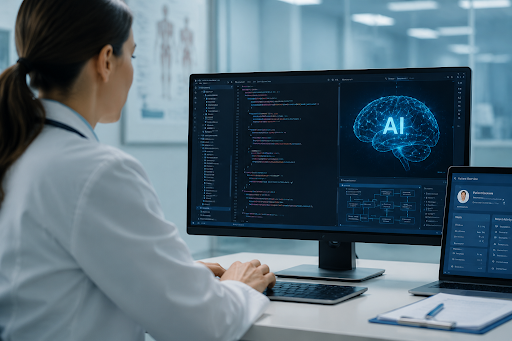
AI-Assisted Development Is Transforming Healthcare Software
The pressure on healthcare companies to provide quality patient care is at an all-time high, as is the pressure to keep operating costs down and comply with stringent government regulations. At the same time, however, the demand for digital solutions, including telemedicine platforms, patient portals, and EHR systems, is ever-increasing.
To cope with these problems, software development teams are increasingly taking advantage of AI-enhanced development processes. Rather than displacing the developer, AI is used to automate monotonous responsibilities, enhance the quality of coding, and improve the speed of the software development process.
What Is AI-Assisted Development?
AI-assisted development refers to the employment of artificial intelligence to facilitate software engineering tasks within the development process. Today’s AI-powered tools can help with:
- Generating and completing code
- Detecting bugs
- Creating tests
- Documenting
- Refactoring code
- Analyzing security
AI enables development teams to automate routine operations, leaving more time for dealing with complex healthcare issues. This is especially valuable when working with an AI assisted development partner.
Reasons Healthcare Software is More Difficult
Healthcare applications have many unique features that make creating these apps much more complicated compared to other types of software.
Legal Compliance
Healthcare software must comply with such legal acts as HIPAA, GDPR, and HITECH, and developers must keep the patients’ data protected.
Data Security
Healthcare applications contain very sensitive patient data, therefore security is a priority among other things. In such cases, secure API, strong authentication, and encryption are critical.
Complex Integrations
Healthcare applications do a lot of integrations because these systems need integration with EHR systems, lab systems, insurance platforms, pharmacies, and people’s health monitoring systems. Many of these integrations involve well-known countries.
High Quality
Software faults greatly influence patient care. Thus, it is extremely important to test the healthcare application carefully before putting it into production.
The Role of Artificial Intelligence in Improving Healthcare Software Development
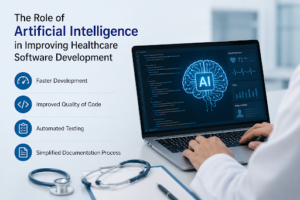
AI-powered programming tools enable developers to produce secure and high-quality software applications in a quick manner.
Faster Development
AI technologies can produce repetitive code elements, reducing the time required to create healthcare software applications while allowing programmers to invest their time in developing functions.
Improved Quality of Code
AI tools are able to identify bugs and flaws in the code before the production phase and suggest improvements.
Automated Testing
Testing is a very labor-intensive process in creating healthcare software products. AI can help to create unit tests, integration tests, and edge cases, which increases the reliability of software products.
Simplified Documentation Process
Keeping documentation up to date is not an easy task, however, AI is able to create API specifications, technical documentation, and developer documentation, which greatly simplifies the work on healthcare applications.
Typical Use Cases in Healthcare
Utilizing AI for development aids many different healthcare processes, including:
- EHR systems
- Telemedicine services
- Remote patient tracking systems
- Health advisory programs
- Hospital managing applications
In all of these instances, AI is used to speed up the development process while consistently producing quality code.
Advantages for Healthcare Organizations
The implementation of AI-powered development has come with several benefits, which include:
- Reduced time to market: Teams are able to launch new features faster.
- Increased productivity of developers: Automation streamlines monotonous coding activities.
- Better quality for software: Continuous code examination makes it possible to eliminate problems early.
- Lower costs for development: Speedier development and decreased number of bugs lead to a drop in costs.
- Easier legacy modernization: AI enables developers to analyze and upgrade old healthcare programs.
Things to Ponder
Although AI-assisted development has many advantages, it must still be implemented cautiously.
Importance of Human Oversight
AI code must always be reviewed by skilled developers because healthcare technologies must always be accurate, safe and compliant, and robots cannot help with that.
Keeping Data Safe
Companies must be sure that AI solutions are in line with their security guidelines and that they do not expose PHI when employing AI tools that are based in the cloud.
Meeting Compliance Requirements
AI can expedite the development process but does not guarantee that regulations are being followed.
Best Practices for Adopting AI-Assisted Development
The healthcare sector can make the most of AI by employing some of the following best practices:
- Set the coding standards in advance of the application of AI-based tools.
- Require the review of AI-generated solutions by an expert.
- Ensure that the whole development process is backed up by automated security checks.
- Prevent sharing private information in public AI solutions.
- Secure the involvement of experienced developers to work alongside AI automation.
- Check on the quality of developed software continuously.
- Teach developers the responsible usage of AI technologies.
Future Implications
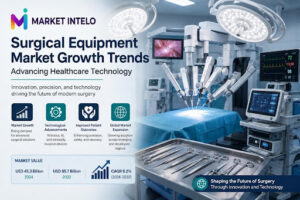
The significance of AI-aided development in contemporary healthcare software engineering cannot be overemphasized. As AI continues to develop, it will improve code production, testing, documentation, and system design across different areas of healthcare, including surgical technology and digital surgical systems. AI can support the development of software used in surgical planning, monitoring, robotic-assisted procedures, and other advanced surgical technologies, helping healthcare professionals work with greater accuracy and efficiency.
AI will not substitute developers but rather allow them to produce their work more productively and efficiently. This can help healthcare companies and surgical technology providers deliver safer, more scalable, and higher-quality software more quickly. For organizations that desire to upgrade existing systems or create new digital healthcare and surgical applications, AI-aided development presents a valuable opportunity to enhance productivity while maintaining quality, reliability, and patient safety.