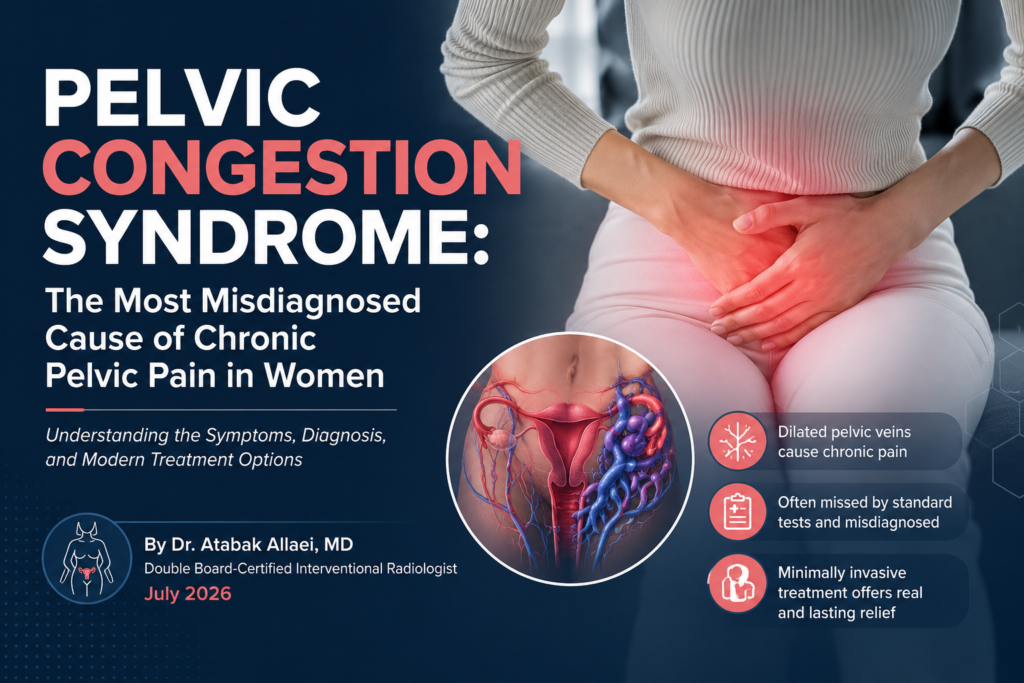
Pelvic Congestion Syndrome: The Most Misdiagnosed Cause of Chronic Pelvic Pain in Women
Pelvic Congestion Syndrome Causes, Symptoms & Treatment
By Dr. Atabak Allaei, MD | Double Board-Certified Interventional Radiologist | July 2026
Imagine living with deep, aching pelvic pain for months — or even years — only to be told by doctor after doctor that nothing is wrong. You are not imagining it. You are not anxious. You are not seeking attention. You are suffering from a very real, very treatable condition that is routinely missed: Pelvic Congestion Syndrome.
Pelvic Congestion Syndrome (PCS) affects an estimated 15% of women worldwide, making it one of the most common yet least recognized causes of chronic pelvic pain. Despite its prevalence, many women spend years seeking a diagnosis before finding answers — and many never do.
This article aims to change that. Here is what every woman should know about PCS: what it is, why it is so often missed, how it is diagnosed, and what modern medicine can do about it.
What Is Pelvic Congestion Syndrome?
Pelvic Congestion Syndrome is a chronic condition caused by dysfunctional veins in the pelvis. Think of it like varicose veins — the kind that appear on the legs — but located deep inside the abdomen and pelvis, where they cannot be seen from the outside.
In a healthy circulatory system, valves inside the veins push blood upward and back toward the heart. When these valves become damaged or weakened, blood flows backward and pools inside the pelvic veins. This pooling causes the veins to dilate and swell, placing constant pressure on the surrounding pelvic organs the uterus, ovaries, and bladder. The result is a dull, heavy, aching pain that many women describe as a constant feeling of fullness or pressure in the lower abdomen.
Who Is at Risk?
PCS is most commonly diagnosed in women between the ages of 20 and 45, though it can affect women at any reproductive age. The following factors increase the risk:
- Multiple pregnancies pregnancy increases blood flow to the pelvis and can stretch and weaken vein walls
- Hormonal influences — estrogen is thought to weaken vein walls, which may explain why PCS almost exclusively affects women of reproductive age
- A retroverted (tilted) uterus — which can obstruct venous drainage
- Polycystic ovaries — enlarged ovaries may compress pelvic veins
- Family history of varicose veins or venous insufficiency
It is worth noting that PCS symptoms often worsen throughout the day, after prolonged standing or sitting, and improve when lying down. This positional pattern is an important diagnostic clue.
Why Is PCS So Often Missed?
The chronic misdiagnosis of PCS is one of the most frustrating realities in women’s healthcare. There are several reasons why this condition is so easily overlooked:
First, pelvic pain itself is a broad and complex symptom. Dozens of conditions — from endometriosis and fibroids to irritable bowel syndrome and interstitial cystitis — can cause similar discomfort. Without specifically testing for venous dysfunction, PCS can be hidden beneath these other diagnoses.
Second, standard imaging tests often miss it. A routine ultrasound or CT scan may not detect dilated pelvic veins if the patient is lying flat, because lying down allows blood to drain and veins to decompress. Specialized imaging techniques, performed with the patient in an upright position or with Valsalva maneuver, are required to properly visualize the abnormal veins.
Third, many healthcare providers are simply not familiar with PCS. It is not always included in standard medical training curricula, and awareness among general practitioners remains limited.
The result? Many women are told their pain is psychological, that they are “just stressed,” or that their test results are normal — when in reality, their veins are visibly dilated and causing real, measurable discomfort.
Symptoms to Watch For
Pelvic Congestion Syndrome presents with a recognizable pattern of symptoms. If you experience several of the following, it may be worth speaking to a specialist:
- A chronic, dull ache in the lower abdomen and pelvis that lasts longer than six months
- Pain that worsens throughout the day and improves after lying down
- Increased pain during or after prolonged standing, walking, or physical activity
- Pelvic pain that worsens during or after sexual intercourse (dyspareunia)
- Pain that intensifies before and during menstruation
- Pressure or fullness in the pelvic region
- Visible varicose veins on the buttocks, thighs, or vulva
- Bladder irritability or urgency without a urinary infection
- Irritable bowel-like symptoms
It is important to note that the severity of symptoms does not always correspond to the degree of venous dilation. Some women with significantly enlarged veins report mild discomfort, while others with moderate dilation experience debilitating daily pain.
How Is PCS Diagnosed?
Diagnosing PCS requires a combination of clinical evaluation and targeted imaging. A thorough medical history — including the nature, timing, and pattern of pelvic pain — is the essential first step.
The following imaging techniques are used to confirm PCS:
- Pelvic Ultrasound with Doppler — A color Doppler ultrasound can visualize blood flow within the pelvic veins and identify venous reflux (backward blood flow). This is often the first-line imaging test, though it requires an experienced sonographer familiar with PCS
- CT or MRI of the Abdomen and Pelvis — Cross-sectional imaging can identify dilated ovarian veins (greater than 6mm is generally considered abnormal), rule out other causes of pelvic pain, and help plan treatment
- Pelvic Venography — Considered the gold standard for diagnosis, this is an X-ray procedure in which contrast dye is injected directly into the pelvic veins to visualize their anatomy and identify areas of reflux or dilation
If you suspect PCS, asking your doctor for a referral to an Interventional Radiologist — a physician who specializes in minimally invasive, image-guided procedures — is often the most direct route to an accurate diagnosis and effective treatment.
Treatment Options: What Are Your Choices?
The good news is that PCS is treatable. Management options range from conservative measures to minimally invasive procedures, depending on the severity of symptoms.
Conservative Management:
- Hormonal therapy — medications such as medroxyprogesterone acetate (Depo-Provera) or gonadotropin-releasing hormone (GnRH) agonists can suppress ovarian function and reduce blood flow to the pelvic veins, providing temporary symptom relief
- Pain management — NSAIDs and other analgesics can help manage day-to-day discomfort
- Compression garments — support stockings may reduce venous pooling in some patients
Minimally Invasive Treatment — Ovarian Vein Embolization:
The most effective and long-lasting treatment for PCS is Ovarian Vein Embolization (OVE), a minimally invasive procedure performed by an Interventional Radiologist. During this procedure:
- A thin catheter (a flexible tube) is inserted through a tiny nick in the skin at the wrist or groin — no large incision required
- Using real-time X-ray guidance, the catheter is guided through the veins to the dilated pelvic veins
- Small metallic coils and/or sclerosing agents are used to close off the abnormal veins, redirecting blood flow through healthier vessels
- The entire procedure typically takes less than one hour and is performed under local anesthesia
- Most patients go home the same day and return to normal activities within a few days
Studies have shown that Ovarian Vein Embolization achieves significant symptom improvement in 75–85% of appropriately selected patients, with durable long-term results. It is a safe, effective alternative to surgery for women who have not responded to hormonal therapy or who prefer to avoid prolonged medication use.
A Word on Emotional Impact
Beyond the physical symptoms, PCS carries a profound emotional burden. Years of unexplained pain, dismissed by medical professionals and misunderstood by family and friends, take a serious toll on mental health. Studies have found higher rates of depression, anxiety, and reduced quality of life among women with chronic pelvic pain.
If this story resonates with you, please know: your pain is real. It has a name, a cause, and effective treatment options. You deserve to be heard, properly evaluated, and properly treated.
The Bottom Line
Pelvic Congestion Syndrome is a common but chronically underdiagnosed condition that causes real, measurable suffering for millions of women around the world. The combination of vague symptoms, limited physician awareness, and inadequate imaging often leaves patients without answers for years.
If you have been living with chronic pelvic pain and have not yet been evaluated for PCS, speak to your doctor about a referral to an Interventional Radiologist. At Surgical Teck, we believe that understanding the underlying cause is an important step toward finding the right treatment. Ask specifically about pelvic venous Doppler ultrasound or pelvic venography. You do not have to keep living with unexplained pain.
The field of Interventional Radiology has made minimally invasive and highly effective treatments for PCS available—treatments that may avoid general anesthesia, hospital admission, and a long recovery in appropriate cases. For the right candidate, these advanced treatment options can be life-changing. Surgical Teck is committed to sharing reliable information about modern, minimally invasive approaches that can help patients make informed decisions about their care.
References
- Stones RW. Pelvic vascular congestion — half a century later. Clinical Obstetrics and Gynecology, 46(4): 831–836, 2003.
- Durham JD, Machan L. Pelvic Congestion Syndrome. Seminars in Interventional Radiology, 30(4): 372–380, 2013.
- Tropeano G, et al. Ovarian vein incompetence: a potential cause of chronic pelvic pain in women. European Journal of Obstetrics & Gynecology, 139(2): 215–221, 2008.
- Kim HS, et al. Embolotherapy for Pelvic Congestion Syndrome. Journal of Vascular and Interventional Radiology, 17(2): 289–297, 2006.
- Ganeshan A, et al. Chronic pelvic pain due to pelvic congestion syndrome: the role of diagnostic and interventional radiology. CardioVascular and Interventional Radiology, 30(6): 1105–1111, 2007.
About the Author
Dr. Atabak Allaei is a double board-certified Interventional Radiologist and Diagnostic Imaging specialist based in Beverly Hills, California. He completed his fellowship training at the Mallinckrodt Institute of Radiology at Washington University and serves as an attending physician at Cedars-Sinai Medical Center. With over 5,000 minimally invasive procedures performed, Dr. Allaei specializes in treating conditions including Pelvic Congestion Syndrome, Uterine Fibroids, and other vascular conditions using the latest image-guided techniques. He is the founder of California Vascular & Interventional (cavascular.com), a Beverly Hills-based practice dedicated to patient education and minimally invasive care.