Next-Generation Surgical Robots: What’s Coming After Da Vinci?
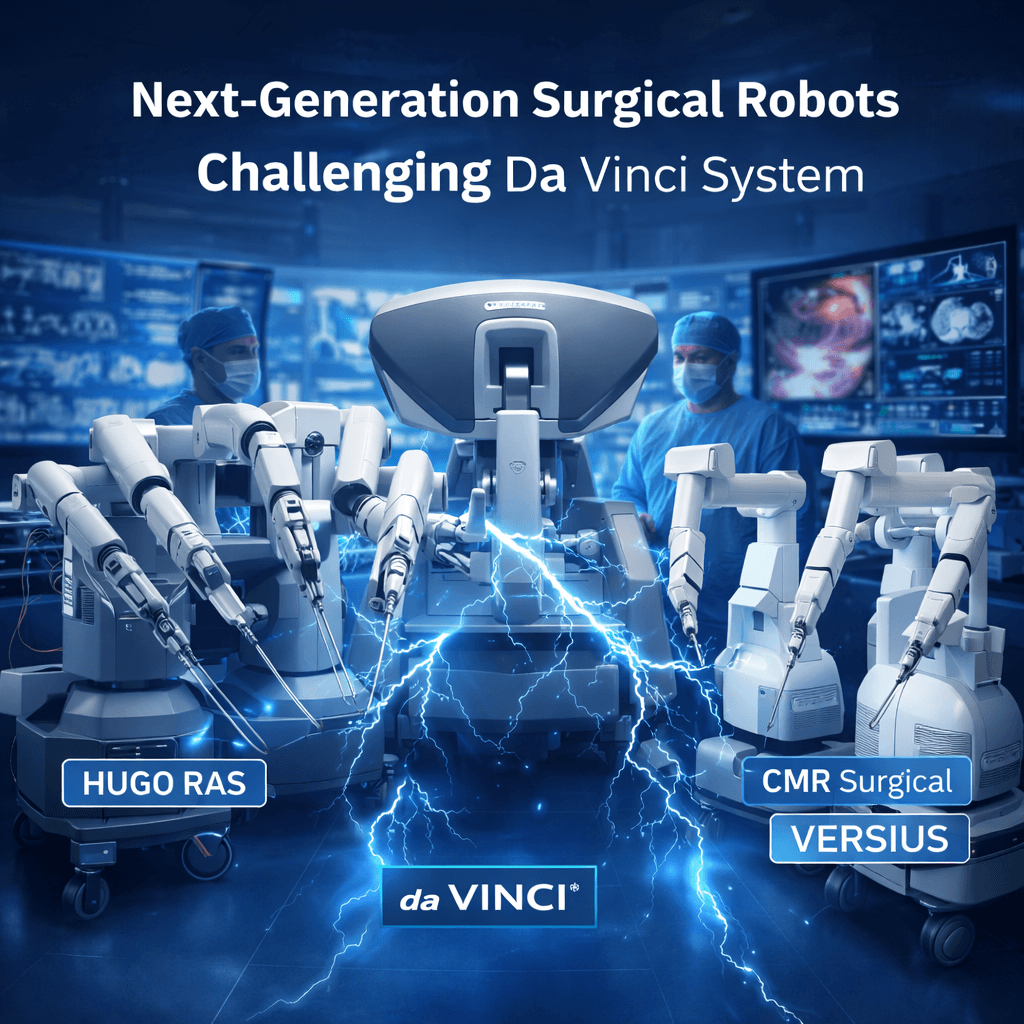
Advanced surgical robots Hugo RAS, CMR Surgical Versius, and Da Vinci in a modern operating room, showcasing cutting-edge robotic surgery technology and AI integration.
For over two decades, Intuitive Surgical’s da Vinci system has dominated the robotic surgery landscape, performing millions of procedures worldwide and becoming virtually synonymous with robotic-assisted surgery itself. However, with more than 8,000 da Vinci units installed globally and over 12 million procedures performed, the field is experiencing an unprecedented wave of innovation as new competitors introduce fresh approaches to robotic surgery.
The next generation of surgical robots promises to reshape the operating room with modular designs, enhanced affordability, improved haptic feedback, and artificial intelligence integration. These emerging platforms aim not to simply replicate da Vinci’s success but to address its limitations while making robotic surgery accessible to more hospitals, surgeons, and patients worldwide.
The Evolution Beyond Da Vinci Dominance
Understanding where surgical robotics is heading requires recognizing why da Vinci achieved such remarkable market dominance. The da Vinci Surgical System was introduced by Intuitive Surgical and cleared by the U.S. Food and Drug Administration in 2000, revolutionizing minimally invasive surgery with its combination of enhanced dexterity, tremor filtration, and three-dimensional visualization.
The system’s success stemmed from its comprehensive ecosystem—advanced instruments, rigorous training programs, extensive service networks, and continuous technological refinement. However, this dominance also created opportunities for competitors to innovate in areas where da Vinci faces limitations: high costs, large physical footprints, lack of haptic feedback, and restrictive proprietary systems.
After many years of monopoly with the da Vinci system, Intuitive Surgical finally faces market competition from international companies vying to occupy the surgical robotics space with their own versions of next generation robots. This competitive landscape promises to accelerate innovation while potentially reducing costs and expanding access to robotic surgery globally.
Medtronic Hugo RAS: The Modular Revolution
Medtronic announced that the U.S. Food and Drug Administration has cleared the Hugo™ robotic-assisted surgery system for use in urologic surgical procedures in December 2025, marking a significant milestone in challenging Intuitive’s market position.
Design Philosophy and Architecture
The Hugo™ Robotic-Assisted Surgery system emphasizes flexibility, portability, and adaptability to different operating room layouts, with each robotic arm functioning as an independent unit mounted on a mobile cart that can be positioned according to surgical approach, patient anatomy, and available space.
This modular configuration represents a fundamental departure from da Vinci’s integrated fixed-tower design. Hospitals can position Hugo’s mobile carts precisely where needed, adapt configurations for different procedures, and potentially share components across multiple operating rooms. This flexibility addresses a common complaint about traditional robotic systems—their inability to accommodate varying OR layouts and multidisciplinary needs.
The system features an open console design rather than da Vinci’s closed immersive environment. This openness provides surgeons with greater situational awareness, reduces physical strain during lengthy procedures, and facilitates better communication with surgical teams. Some surgeons prefer this approach as it maintains connection with the operating room environment while still providing the precision benefits of robotic control.
Digital Integration and AI Analytics
Hugo RAS connects seamlessly with Medtronic’s Touch Surgery ecosystem, which provides pre-operative training tools, remote tele-proctoring capabilities, and AI-powered post-operative insights. Surgeons can access case videos within minutes after completing procedures, enabling immediate review and continuous improvement.
The Touch Surgery platform automatically segments surgical videos into procedural steps, benchmarks performance against historical cases, and identifies areas for technique refinement. This data-driven approach to surgical education and quality improvement represents a significant advancement beyond traditional training methods.
Clinical Performance and Market Position
Early clinical results demonstrate that Hugo performs comparably to da Vinci in key metrics. Studies show similar perioperative outcomes, oncologic results, and patient satisfaction scores, particularly for common urologic procedures like radical prostatectomy and nephrectomy.
Hugo targets new adopters, whereas da Vinci maintains dominance in high-volume, complex surgical environments. Medtronic positions Hugo as a more accessible entry point for hospitals establishing robotic surgery programs or seeking to expand capacity without the higher capital investment required for additional da Vinci systems.
CMR Surgical Versius: Portable Precision
CMR Surgical received FDA clearance for its Versius Plus soft tissue platform in December 2025, bringing the second most widely used soft tissue surgical robot globally to the market alongside new advanced features.
Biomimetic Design Principles
Versius was designed to mimic the human arm’s natural movement and range of motion. Each robotic arm operates independently on its own mobile cart, providing surgeons exceptional flexibility in port placement and approach angles. This biomimetic philosophy aims to make the transition from laparoscopic to robotic surgery more intuitive for experienced surgeons.
The system’s compact footprint allows it to fit into operating rooms where larger fixed-tower systems cannot, expanding robotic surgery access to smaller facilities and ambulatory surgery centers. Hospitals can easily move Versius between ORs, maximizing utilization across departments and procedure types.
Versius Plus Enhancements
The latest Versius Plus iteration includes several notable improvements over the original system. Integrated fluorescence visualization technology enables real-time imaging for enhanced tissue differentiation during procedures. The platform supports multiple visualization modes with overlay and grayscale options, helping surgeons identify critical anatomical structures more clearly.
CMR Surgical also offers Versius Connect, a dedicated surgeon application providing near-real-time procedure logbooks and performance tracking. This digital connectivity mirrors industry trends toward data-driven surgical practice and continuous quality improvement.
Global Reach and Adoption
UK-based CMR Surgical’s Versius has been used in more than 30,000 surgical procedures in over 30 countries, making it the second most popular soft tissue surgical robot worldwide. The system has established strong presence in Europe, India, and other international markets where cost considerations and space constraints make traditional fixed-tower systems less practical.
Emerging Competitors and Regional Innovation
Beyond Hugo and Versius, numerous other platforms are entering the market, particularly from Asian manufacturers seeking to establish positions in their rapidly growing regional markets.
Asian Market Leaders
SuZhou KangDuo Robot Co. created the KangDuo Surgical Robot System for urological procedures, with a prospective randomized trial of 100 patients finding the system non-inferior to da Vinci for partial nephrectomy. Chinese systems offer significant cost advantages while demonstrating comparable safety and efficacy in clinical studies.
Several platforms including REVO-I, Hinotori™, Senhance™, KangDuo, MicroHand S, Dexter™, and Toumai® have entered clinical use with early results demonstrating perioperative and short-term oncologic outcomes broadly comparable to established systems, particularly for procedures like radical prostatectomy, partial nephrectomy, and radical cystectomy.
The Korean-developed REVO-I system features an open console with 3D-HD visualization and has successfully completed clinical trials in multiple surgical specialties. Japan’s Hinotori platform represents that nation’s entry into domestic surgical robotics manufacturing, backed by significant government and corporate investment.
Single-Port and Specialized Systems
While multi-port systems dominate the market, single-port platforms represent an important niche for certain procedures. Intuitive’s da Vinci SP system creates a solitary port through a small incision, deploying one camera and three robotic arms controlled from the console similar to larger systems. This approach provides better cosmetic outcomes and potentially faster recovery for appropriate procedures.
Specialized orthopedic robots like Stryker’s Mako and Zimmer Biomet’s ROSA continue advancing in joint replacement surgeries. These platforms leverage AI to convert pre-operative imaging into precise 3D surgical plans, optimizing implant positioning and alignment with remarkable consistency.
Key Technological Advances Across Platforms
Several technological themes emerge across next-generation surgical robots, representing the industry’s collective response to limitations in earlier systems.
Haptic Feedback Integration
One of the most significant limitations of the da Vinci system is its lack of haptic feedback—surgeons cannot feel tissue resistance or instrument forces during procedures. At present, the Senhance surgical system and MAKO RIO surgical system are the only commercially available surgical robotic systems providing haptic feedback.
Haptic technology allows surgeons to feel what robotic instruments encounter, providing tactile information about tissue density, suture tension, and manipulation forces. This sensory feedback can prevent tissue damage, improve suturing quality, and enhance overall surgical precision. As this technology matures, it’s becoming a standard feature in newer platforms.
Open Console Architectures
Open consoles, lighter instruments, and greater portability will be recurring themes in these next-generation systems. Unlike da Vinci’s immersive closed console, open designs maintain the surgeon’s visual and auditory connection with the operating room environment.
This architectural choice offers several advantages: easier communication with surgical teams, reduced claustrophobia during lengthy procedures, enhanced teaching opportunities for residents and fellows, and better situational awareness during emergencies. While some surgeons prefer the focused immersion of closed consoles, many appreciate the flexibility and connectedness of open designs.
Artificial Intelligence Integration
AI capabilities extend far beyond post-operative analytics in next-generation systems. Machine learning algorithms provide real-time surgical guidance by analyzing video feeds and identifying anatomical structures, predicting optimal instrument paths, detecting potential complications before they occur, and offering technique suggestions based on vast databases of previous procedures.
The MAKO robotic system leverages AI to convert preoperative CT scans into 3D joint models, with ML algorithms optimizing implant size, alignment and ligament balance during total knee and hip replacements. Similar AI integration is expanding across soft-tissue platforms, promising increasingly intelligent surgical assistance.
Cost Reduction Strategies
A da Vinci system costs between $1.5 million and $2.5 million depending on the model and configuration, with annual maintenance, service, and disposable instrument costs typically adding $100,000 to $300,000 per year. These substantial expenses limit robotic surgery access, particularly in resource-constrained healthcare settings.
Newer platforms pursue various cost-reduction approaches including modular designs allowing phased capital investment, open architecture systems reducing proprietary instrument expenses, smaller physical footprints lowering facility modification costs, and comprehensive service packages spreading expenses predictably over time. While total ownership costs remain significant, these strategies make robotic surgery more accessible to mid-sized hospitals and international markets.
Clinical Applications and Expanding Specialties
Next-generation robots are broadening the range of procedures suitable for robotic assistance while deepening capabilities in established specialties.
Urology and Gynecology
Urology remains the largest clinical application for robotic surgery, with prostatectomy being the most common robotic procedure worldwide. New platforms demonstrate comparable or superior outcomes for radical prostatectomy, partial and radical nephrectomy, cystectomy, and pyeloplasty procedures.
Gynecologic surgery represents another major application area, with robotic assistance increasingly used for hysterectomy, myomectomy, endometriosis treatment, and oncologic procedures. The precision and visualization provided by robotic systems offer particular advantages in the confined pelvic space.
General and Colorectal Surgery
Robotic platforms are expanding rapidly in general surgery applications. Cholecystectomy, hernia repair, bariatric surgery, and colorectal procedures benefit from robotic precision and minimally invasive approaches. In a prospective study, 30 patients undergoing right or left colectomy with a miniaturized robotic surgical system experienced no conversions to open surgery, no system-related adverse events and a low overall morbidity rate, with median hospital stay of only two days compared to median of 6 days for open colectomy.
Thoracic and Cardiac Surgery
Robotic thoracic surgery enables minimally invasive approaches to lung resections, mediastinal procedures, and esophageal surgery. Cardiac applications include mitral valve repair, coronary artery bypass grafting, and atrial fibrillation ablation procedures performed through small incisions rather than traditional sternotomy.
Pediatric Applications
Pediatric surgery represents an emerging frontier for robotic systems. Small patient size requires exceptional precision and delicate tissue handling—areas where robotic assistance provides significant advantages. Platforms are increasingly receiving regulatory clearances for pediatric indications, expanding surgical options for young patients.
Challenges Facing Next-Generation Platforms
Despite impressive technological advances, new robotic systems face substantial obstacles in challenging da Vinci’s established position.
Market Penetration Barriers
Intuitive Surgical’s installed base creates powerful network effects. With over 10,000 da Vinci systems deployed globally and tens of thousands of surgeons trained on the platform, switching costs are substantial. Hospitals must invest in new training, establish different supply chains, and convince surgeons to learn unfamiliar systems.
The company’s extensive service networks, remote monitoring capabilities, and dedicated support teams provide reliability and responsiveness difficult for newer entrants to match immediately. These operational advantages complement da Vinci’s technological strengths.
Regulatory Pathways and Timelines
Obtaining regulatory approvals across multiple markets requires significant time and resources. CMR Surgical’s Versius is still awaiting FDA clearance but is already in use in Europe, India, and other markets, demonstrating the complexity of navigating different regulatory environments.
Clinical trial requirements, safety demonstrations, and regulatory review processes can delay market entry by years. During this time, established competitors continue advancing their own technologies and strengthening market positions.
Cost Considerations and Value Proposition
While new platforms tout lower acquisition costs, total ownership calculations remain complex. Hospitals evaluate not just purchase prices but also maintenance expenses, instrument costs, training requirements, and procedural volumes needed to justify investment.
Demonstrating clear value propositions—whether through superior outcomes, enhanced efficiency, or expanded access—is essential for market success. Simply matching da Vinci’s performance at slightly lower cost may not suffice to overcome switching barriers and learning curves.
Technology Learning Curves
Both surgeons and surgical teams require substantial training to achieve proficiency with new robotic platforms. Early adoption periods often show longer operative times and higher complication rates before teams develop expertise.
This learning curve creates risk for hospitals and surgeons, potentially affecting patient outcomes and satisfaction during transition periods. Comprehensive training programs and ongoing support become critical differentiators among competing platforms.
The Future Landscape of Robotic Surgery
Looking beyond 2026, several trends will likely shape surgical robotics evolution over the coming decade.
Increased Automation and Autonomy
The STAR robot can suture bowel better than a human hand through supervised autonomous suturing, amalgamating 3-dimensional imaging and sensors to partake in intestinal anastomosis. While fully autonomous surgery remains distant, semi-autonomous capabilities for specific surgical tasks will expand.
Systems may independently perform routine suturing, tissue retraction, or instrument passing under surgeon supervision, allowing surgeons to focus on complex decision-making and critical procedure elements. This collaborative approach between human expertise and machine precision represents the likely path forward.
5G Connectivity and Telesurgery
High-speed, low-latency 5G networks enable true telesurgery where expert surgeons operate on patients in remote locations through robotic systems. This capability could address surgical access disparities, enable immediate expert consultation during complex cases, and facilitate global surgical education.
Remote proctoring and virtual training already leverage connectivity advances. As networks improve and latency decreases further, distance between surgeon and patient will become increasingly irrelevant for many procedures.
Artificial Intelligence Advancement
AI systems will evolve from passive observers providing post-operative analytics to active surgical participants offering real-time guidance. Computer vision algorithms will identify anatomical structures with increasing accuracy, predict complications before they manifest, suggest optimal approaches based on patient-specific factors, and continuously learn from global surgical databases.
This intelligence augmentation will democratize expertise, helping less-experienced surgeons perform complex procedures safely while giving experts tools to push boundaries of what’s surgically possible.
Market Consolidation and Standardization
As competition intensifies, market consolidation seems inevitable. Smaller players may be acquired by larger medical device companies, platforms may merge to combine complementary strengths, and industry standards may emerge around interoperability and data sharing.
This consolidation could accelerate innovation by combining resources while potentially reducing equipment costs through economies of scale and standardization. However, it also risks reducing competitive pressure that drives current rapid advancement.
FAQs
What are the main differences between new surgical robots and da Vinci systems?
Newer systems like Hugo and Versius feature modular designs with mobile carts and open consoles that offer greater flexibility in OR layout, faster setup, and lower footprint, unlike fixed-tower designs. Many also include haptic feedback and AI-powered analytics unavailable in earlier da Vinci models.
Are next-generation surgical robots as safe and effective as da Vinci?
Clinical studies demonstrate that newer platforms like Hugo RAS and Versius achieve comparable perioperative outcomes and oncologic results to da Vinci for procedures like prostatectomy and nephrectomy. Safety profiles appear similar when surgical teams have adequate training and experience with the platforms.
How much do next-generation surgical robots cost compared to da Vinci?
While exact pricing varies, newer platforms are generally marketed as more affordable alternatives to da Vinci’s $1.5-$2.5 million price tag. However, total ownership costs depend on case volume, maintenance fees, and disposable instrument expenses, making direct comparisons complex across different hospital settings and utilization patterns.
Which surgical specialties benefit most from robotic assistance?
Urology leads in robotic procedure volume, particularly for prostatectomy, followed closely by gynecology for hysterectomy and other procedures. General surgery, colorectal surgery, and thoracic surgery are experiencing rapid robotic adoption growth, while orthopedic and cardiac applications continue expanding with specialized platforms.
Will robotic surgery eventually replace traditional laparoscopic techniques?
Robotic systems will likely complement rather than completely replace laparoscopic surgery. While robotics offer advantages for complex procedures requiring exceptional precision, traditional laparoscopy remains efficient and cost-effective for many routine operations. The future surgical landscape will probably include both approaches selected based on procedure complexity, patient factors, and resource availability.
Conclusion
The surgical robotics landscape is experiencing its most dynamic period since da Vinci’s introduction over two decades ago. New platforms from Medtronic, CMR Surgical, and emerging international competitors are challenging Intuitive Surgical’s dominance with innovative approaches addressing cost, flexibility, and technological limitations.
These next-generation systems share common themes: modular architectures for enhanced adaptability, open consoles improving communication and reducing fatigue, haptic feedback providing tactile information, AI integration enabling smarter surgical assistance, and cost structures making robotic surgery more accessible globally.
Clinical results demonstrate that these newer platforms can match da Vinci’s performance in key procedures while offering distinct advantages in specific contexts. However, Intuitive Surgical’s established market position, extensive installed base, comprehensive support networks, and continuous innovation through systems like the da Vinci 5 with force-sensing technology ensure ongoing competition rather than displacement.
For healthcare systems, surgeons, and patients, this competition promises accelerated innovation, improved access to robotic surgery, and continued evolution toward safer, more efficient, and more effective surgical care. The question is no longer whether alternatives to da Vinci can succeed but rather how the expanding ecosystem of robotic platforms will collectively transform surgery for the better.
The next generation of surgical robots isn’t simply coming—it has arrived, and it’s reshaping the future of surgery worldwide.